Guide
Vegetable Garden Layout and Raised Bed Layout
By the editorial team · Updated 2026-11-19 · Every pairing linked to its source
Quick answer. Good vegetable garden layout puts tall crops on the north side, gives each plant its full spacing, keeps herbs and flowers along the edges and puts foes such as tomatoes and potatoes in different beds. In a raised bed, plan by the square foot: a 4 x 8 ft bed fits four staked tomatoes with basil, marigolds, lettuce and carrots.
Your vegetable garden layout decides more than how the beds look. It sets how much sun each plant gets, whether companions can actually reach the crop they're meant to help, and how easy next year's rotation will be.
This guide covers the layout rules that hold for any size of plot, then walks through a raised bed layout plant by plant.
Seven principles of a vegetable garden layout
- Tall on the north side. In the Northern Hemisphere, put tomatoes, trellised cucumbers, pole beans and corn along the north edge so they don't shade shorter crops. Sunflowers belong there too. (In the Southern Hemisphere, flip it.)
- Use real spacing. Each crop has a spacing range; crowding is the most common reason a companion pair fails. Iowa State found squash outcompeted beans in a Three Sisters planting when it had the upper hand.
- One family per bed. Grouping a family together makes crop rotation a matter of moving whole beds.
- Foes in different beds, not just different rows. Late blight passes between tomatoes and potatoes, so a foot of distance isn't enough.
- Permanent plants on the edges. Asparagus, rhubarb and berry bushes stay for years, so give them a bed edge or their own bed where annual digging won't disturb them.
- Dry-soil herbs at the dry end. Thyme is a good bed-edge plant; rosemary and lavender want the sunny, free-draining end of a bed, not the middle of a watered row.
- Mint in a pot. Always.
How to place companions in a raised bed
Companions work at short range, so where you put them matters:
- Underplant, then step aside. Lettuce under young tomatoes uses shaded space before the tomatoes fill in (Oregon State). The RHS describes the same idea for fast crops like lettuce and radish sown between slow, large crops such as Brussels sprouts or sweet corn, harvested before they're shaded out.
- Fill the gap in time. Sow spinach early where tomatoes or peppers will go, then transplant them in as you harvest (University of Minnesota).
- Trap crops at the end. An arugula strip sown 1-2 weeks before your brassicas draws flea beetles. Put it at one end of the bed, where it's easy to inspect and remove.
- Flowers on the perimeter. Marigolds and nasturtiums ring squash and cabbage; borage goes at the row end. Edges keep flowers from shading the crop.
- Interplant for scent and camouflage. Young onions between carrot rows reduced carrot fly in a UK trial, and the RHS reports clover underplanting makes cauliflower harder for cabbage root fly to find.
- Go vertical. Trellised cucumbers free ground for low crops, and peas grow well as double rows either side of a trellis, with lettuce or spinach at their feet.
Raised bed garden layout: a worked 4 x 8 ft tomato bed
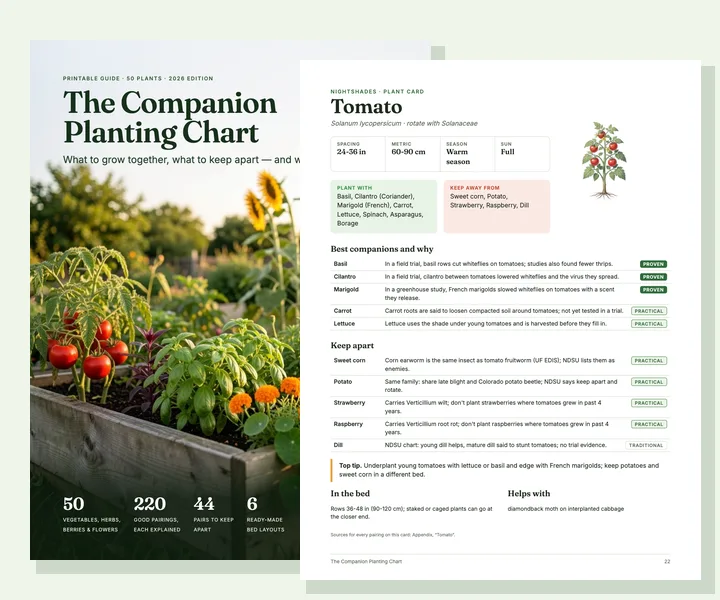
A 4 x 8 ft (1.2 x 2.4 m) bed divided into 1-foot squares gives 32 squares. Here is a tomato bed built entirely from listed companions, with the tall side to the north:
- Back row (north): 4 tomatoes, staked, each taking a 2 x 2 ft block along the north edge.
- Next row: basil, one per square, in front of each tomato. Tomato and basil sharing a bed gave a bigger combined harvest than either alone in West Virginia trials.
- Between the basil: French marigolds, one per square. Both basil and marigolds reduced whitefly on tomato in separate published studies.
- Middle: lettuce, one per square. It uses the space while the tomatoes are small and is harvested before they close in.
- Front row (south): carrots, about 16 per square, sown thinly where they get full sun.
Nothing on the tomato's foe list is in the bed: no potatoes, no sweet corn. Swap basil for cilantro, marigold for nasturtium, or lettuce for spinach in spring, and the logic still holds.
Six bed plans in the kit
The printable kit includes six layouts drawn to scale, with plant counts:
- The classic 4 x 8 ft tomato bed described above.
- A square-foot bed for a small space.
- A Three Sisters planting with squash spaced so it doesn't smother the beans.
- A salsa garden.
- A pizza garden.
- A pollinator bed for the vegetable garden, built from the flowers in our companion flowers guide.
Each plan follows the same rules as this page, so you can adapt them to a bed of a different size.
Layout mistakes to avoid
- Planting a sunflower row on the south side, where it shades everything behind it.
- Tilling sunflower stalks back into a bed you're about to sow; lab studies show its residues inhibit germination, so pull stalks and roots instead.
- Siting a new strawberry or raspberry bed where tomatoes, peppers, eggplant or potatoes grew in the last 4-5 years.
- Building the vegetable bed under a black walnut. Juglone injures tomatoes, peppers, potatoes, eggplant, cabbage, asparagus and rhubarb; keep beds outside the drip line (Purdue, UW).
- Giving pumpkins and winter squash less than 4-5 ft (120-150 cm) per plant.
Spacing chart
| Plant | Inches | cm | Notes |
|---|---|---|---|
| Tomato | 24-36 | 60-90 | Rows 36-48 in (90-120 cm); staked or caged plants can go at the closer end. |
| Pepper | 12-24 | 30-60 | Rows about 36 in (90 cm). |
| Eggplant | 18-24 | 45-60 | Rows about 36 in (90 cm). |
| Potato | 12 | 30 | Seed pieces 2-3 in deep; rows about 36 in (90 cm) to allow hilling. |
| Cucumber | 24 | 60 | Rows 48-72 in (120-180 cm) on the ground; trellising saves space. |
| Zucchini | 24 | 60 | Rows 48-72 in (120-180 cm); bush plants spread wide. |
| Winter squash | 48-60 | 120-150 | Rows about 96 in (240 cm); vining types need the most room. |
| Pumpkin | 48-60 | 120-150 | Rows 72-90 in (180-230 cm). |
| Watermelon | 48-60 | 120-150 | Rows 72-90 in (180-230 cm). |
| Cantaloupe | 18-24 | 45-60 | Rows 48-72 in (120-180 cm). |
| Beans | 3-5 | 8-12 | Bush beans 3-5 in, rows 36 in; pole beans 6-12 in (15-30 cm) along supports, rows 48-60 in. |
| Peas | 2-4 | 5-10 | Rows 12-24 in (30-60 cm); double rows either side of a trellis work well. |
| Broccoli | 18-24 | 45-60 | Rows about 36 in (90 cm). |
| Cabbage | 12-18 | 30-45 | Rows about 36 in (90 cm). |
| Kale | 8-12 | 20-30 | Rows about 36 in (90 cm); harvest outer leaves. |
| Cauliflower | 18-24 | 45-60 | Rows about 36 in (90 cm). |
| Brussels sprouts | 18-24 | 45-60 | Rows about 36 in (90 cm); long season leaves room to interplant early. |
| Onion | 3-4 | 8-10 | Rows 12-24 in (30-60 cm); sets 1.5-2 in deep. |
| Garlic | 6 | 15 | Cloves 1 in deep; rows 18-36 in (45-90 cm). |
| Carrot | 1-2 | 2.5-5 | Thin after emergence; rows about 18 in (45 cm). |
| Beet | 2-3 | 5-8 | Each seed ball gives several seedlings - thin; rows about 18 in (45 cm). |
| Sweet potato | 12 | 30 | Slips on raised ridges; rows 36-48 in (90-120 cm). |
| Radish | 2-3 | 5-8 | Spring radish; fall/winter radish 4-6 in. Rows 12-18 in (30-45 cm). |
| Lettuce | 4-12 | 10-30 | Leaf lettuce at the close end, heads at the wide end; rows 18-24 in. |
| Spinach | 3-6 | 8-15 | Rows 12-18 in (30-45 cm). |
| Swiss chard | 6-8 | 15-20 | Rows 18-24 in (45-60 cm). |
| Arugula | 6 | 15 | Sow thickly and thin gradually to 6 in, eating the thinnings (Cornell). |
| Celery | 12 | 30 | Rows about 24 in (60 cm) (Utah State). |
| Asparagus | 18-24 | 45-60 | Crowns 8 in deep; rows about 48 in (120 cm); permanent bed. |
| Rhubarb | 36 | 90 | Rows 35-48 in (90-120 cm); permanent planting, give it a bed edge. |
| Sweet corn | 8-12 | 20-30 | Rows about 36 in (90 cm). |
| Okra | 12-18 | 30-45 | Rows about 36 in (90 cm); plants get tall. |
| Strawberry | 18-30 | 45-75 | Matted row: plants 18-30 in apart, rows 3-4 ft apart (Illinois). RHS: 35-40 cm apart, rows ~75 cm. |
| Blueberry | 48-60 | 120-150 | Southern highbush 4-5 ft in row, 8-10 ft between rows (Clemson). RHS: 1-2 m apart by variety. Grow 2+ varieties for better cross-pollination. |
| Raspberry | 16-24 | 40-60 | RHS: 40-60 cm apart, rows 1.5-2 m. UMaine: crowns ~2 ft apart, rows 8-12 ft. Don't plant under the canes (RHS). |
| Basil | 12 | 30 | Texas A&M: 12 in apart; pinch often to keep bushy. RHS minimum 10 cm. |
| Dill | 8-12 | 20-30 | Thin to 12 in (Texas A&M) or ~20 cm (RHS). Tall (2-3 ft); self-sows if seed drops. |
| Cilantro | 10 | 25 | Texas A&M: thin to 10 in for full plants/seed; RHS sows 5 cm apart for leaf harvest. Bolts fast in heat - succession sow. |
| Rosemary | 24 | 60 | Texas A&M: 24 in apart. Woody shrub with a big root system - can compete with small crops (OSU). Not hardy in cold-winter areas; pot it. |
| Parsley | 6-12 | 15-30 | Texas A&M 6-8 in; RHS 15-30 cm. Biennial - flowers (and attracts beneficials) in its second year. |
| Thyme | 8-12 | 20-30 | Texas A&M 10-12 in; RHS 20-30 cm. Needs sharp drainage; good bed-edge plant. |
| Oregano | 8-12 | 20-30 | Texas A&M 8-10 in; RHS 20-30 cm. Spreads to 30-60 cm; trim after flowering. |
| Sage | 24-30 | 60-75 | Texas A&M: 30 in apart; RHS: plants reach 30-90 cm across. Needs well-drained soil. |
| Chives | 6-8 | 15-20 | RHS: clumps at least 15 cm apart; Texas A&M 5 in. Deadhead to stop self-seeding. |
| Mint | 8-10 | 20-25 | Invasive: spreads by rhizomes. Grow in a pot, or a bottomless pot sunk in the soil (RHS). Texas A&M: 8-10 in apart. |
| Lavender | 18-36 | 45-90 | Texas A&M 18 in; RHS 90 cm in groups, 30-45 cm for a hedge. Needs sharp drainage, poor-moderate soil, tolerates chalky/alkaline. |
| Marigold | 8-10 | 20-25 | French marigold 8-10 in, African 12-16 in (Clemson). For nematode control plant densely (<7 in) as a solid block the season before (UF/IFAS). |
| Nasturtium | 10-12 | 25-30 | Bush types ~30 cm tall; trailing types to 2.5 m (RHS). Thin to ~12 in. Best flowering on poor soil (RHS). |
| Sunflower | 12-15 | 30-38 | UGA: thin to 12-15 in, rows 2-3 ft; giant types need more, dwarf less - follow the packet. Plant on the north side so it doesn't shade crops. |
| Borage | 12 | 30 | Texas A&M: 12 in apart, direct-seed in early spring. Self-seeds freely - deadhead or pull extras. |
Free printable PDF
Get the complete companion planting chart
Print all six bed plans from the kit, drawn to scale with plant counts, and take the one you need straight to the garden.
- 1-page fridge chart + full 50 × 50 matrix
- 50 plant cards with spacing and reasons
- 6 bed plans drawn to scale
- US Letter and A4
Frequently asked questions
How do you design a raised bed garden?
Start with the main crop and its spacing, then place tall plants on the north side and shorter ones to the south. Fill shaded or empty space with quick crops like lettuce, add one or two companions with a proven reason, and keep foes in a different bed. Draw it on graph paper with one square per foot.
What vegetables should not be planted close together?
Tomatoes and potatoes, which share late blight; tomatoes and sweet corn, which share the corn earworm; and pumpkins or winter squash with sweet potatoes, whose vines tangle. Extension charts also separate the onion family from beans and peas, though that rule is based on lore rather than trials.
What vegetables should not be grown in a raised bed?
Big sprawlers are the hardest fit: pumpkins, winter squash and watermelons each want 48-60 inches (120-150 cm), which can fill a small bed on their own. Permanent crops like asparagus, rhubarb and raspberries do better in a bed of their own, since you can't dig or rotate a shared bed around them.
What is companion planting in a vegetable garden layout?
It means placing plants that help each other within reach of one another, and keeping problem pairs apart. In practice: basil and marigolds near tomatoes, onions among carrots, an arugula trap strip beside brassicas and borage near strawberries, all within a layout that still gives each crop its full spacing.
Sources
- rhs.org.uk — companion planting
- extension.oregonstate.edu — companion planting
- extension.umn.edu — companion planting home gardens
- agris.fao.org — 65deb2ea0f3e94b9e5d08c14
- orgprints.org — 6614
- doi.org — agronomy6030042
- doi.org — journal.pone.0213071
- ojs.ethnobiology.org — 721
- ag.ndsu.edu — expect disease problems on potatoes and tomatoes
- extension.purdue.edu — ho 193
- hort.extension.wisc.edu — walnuttoxicity
- rhs.org.uk — grow your own