Flowers
Borage Companion Plants
By the editorial team · Updated 2026-11-19 · Every pairing linked to its source
Quick answer. Strawberries are borage's best companion: in a UK trial they gave about 35% more fruit and 32% more weight beside borage. Squash, cucumbers, melons, pumpkins, tomatoes and blueberries are listed partners, mostly because borage draws bees. No chart lists a foe, but borage self-seeds freely, so deadhead or pull extras.
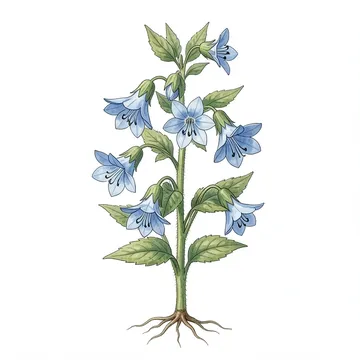
- Spacing
- 12 in · 30 cm
- Season
- Cool season
- Sun
- Full
- Rotate with
- Boraginaceae
Borage companion plants are mostly about what borage does for its neighbors. It is a magnet for honey bees, bumble bees and hoverflies, and it also attracts predatory insects, including a parasitoid wasp that attacks aphids. Few garden flowers have as much research on what they bring to a crop.
The headline result is from strawberries. Griffiths-Lee, Nicholls and Goulson (2020) found strawberries grown with borage produced more and better fruit, with more fly visitors. A University of Minnesota trial saw mostly honey and bumble bees visiting a borage strip at the end of strawberry rows. Beyond berries, borage is a natural partner for any bee-pollinated crop.
Borage companion chart
Good companions
| Plant | Why | Evidence | |
|---|---|---|---|
| Strawberry | In a garden trial, strawberries next to borage gave about 35% more fruit and 32% more weight. | Proven | source |
| Zucchini (summer squash) | Borage brings bees, and zucchini needs bee visits to set fruit. | Practical | source |
| Tomato | Borage is said to deter tomato hornworms; an old idea, untested. | Traditional | source |
| Winter squash | Winter squash is a traditional borage companion; no trial yet. | Traditional | source |
| Cucumber | Tradition says borage helps most crops, cucumbers especially; untested. | Traditional | source |
| Cantaloupe (melon) | Melons are traditionally among borage's best partners; no trial yet. | Traditional | source |
| Pumpkin | A traditional pairing; borage flowers draw bees to pumpkins. | Traditional | source |
| Watermelon | A traditional pairing; borage flowers bring bees to pollinate melons. | Traditional | source |
| Blueberry | Blueberries need bee pollination, and borage draws bees; this exact pairing is untrialed. | Traditional | source |
Keep apart
No well-documented conflicts. See the notes below for general cautions.
Proven Backed by a field trial or published study. Practical Recommended by a university extension or the RHS, with a clear reason. Traditional Gardener lore; no trial found yet.
What to Plant With Borage
Berries
- Strawberry — Proven. In the UK trial, strawberries next to borage gave about 35% more fruit and 32% more weight. It is a single study, so promising rather than settled.
- Blueberry — Traditional. Blueberries need bee pollination and borage brings bees, but no trial has tested this pair.
Squash and melons
- Zucchini — Practical. The UF herb chart lists borage with squash, and bee-pollinated squash gains from more visitors.
- Winter squash and pumpkin — Traditional. Listed by the UF herb chart and the Almanac.
- Cucumber, cantaloupe and watermelon — Traditional. Oregon State says borage enhances most crops, notably cucumber and melon.
Tomatoes
- Tomato — Traditional. The UF herb chart and NDSU list borage with tomatoes and say it deters tomato hornworm. That claim has not been trial-tested.
The common thread is pollination. Strawberries, squash, melons and blueberries all set fruit only when insects carry pollen, so a plant that pulls in bees and flies earns its place next to them. Borage is a cool-season plant that Texas A&M direct-seeds in early spring, so it can go in well before the warm-season squash and melons.
What Not to Plant With Borage
No chart we used lists a plant that should not grow near borage. The practical caution is how readily it spreads by seed. Texas A&M notes borage self-seeds freely, so a single plant can become a patch the following year.
- Deadhead spent flowers before seed drops if you want to keep it in one place.
- Pull extra seedlings in spring; they come out easily when young.
- Keep it at row ends rather than inside tight beds of small crops, where seedlings would crowd them.
Borage Companion Plants for Strawberries
The top tip from our sources is to sow a patch of borage at the end of strawberry or squash rows. That is close to how both berry trials were set up:
- Direct-seed borage in early spring, about 12 in (30 cm) apart, as Texas A&M advises.
- Put it in a short strip at the end of the strawberry rows, not between plants.
- Let it flower through the berry season.
- Deadhead or thin afterward so it does not take over.
The Minnesota trial found berry weight may be higher near borage, but the result was preliminary. Combined with the UK trial, the evidence points the same way. See the strawberry page for the soil and rotation rules that matter even more.
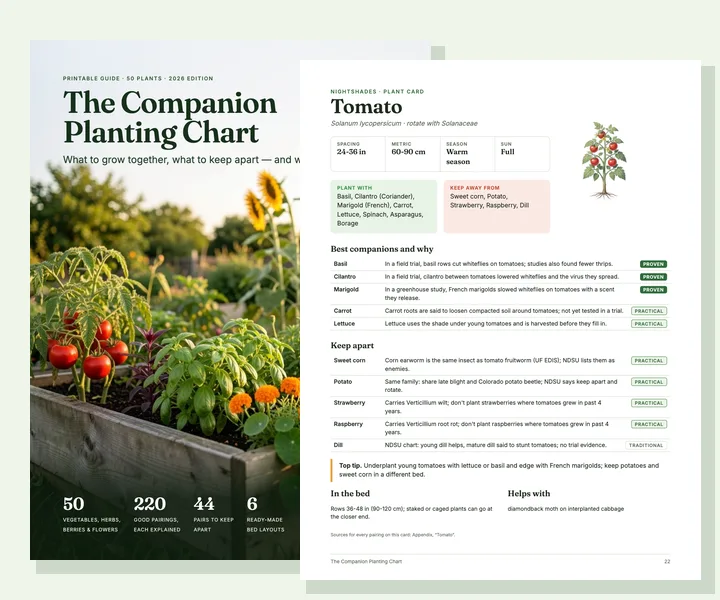
Free printable PDF
Get the complete companion planting chart
The PDF's strawberry bed plan shows the borage strip at the row ends, drawn to scale, so you can copy the trial setup in your own garden.
- 1-page fridge chart + full 50 × 50 matrix
- 50 plant cards with spacing and reasons
- 6 bed plans drawn to scale
- US Letter and A4
Borage and Aphid Control
Borage also helps in a less obvious way. Fujinuma and colleagues (2010) found that aphid-infested borage gives off scents that attract Aphidius colemani, a parasitoid wasp that lays its eggs in aphids. Borage is used as a banker plant in strawberry greenhouses for this reason: it holds a small aphid population that keeps the wasps around. In a garden, that is one more reason to let borage stand near crops that suffer from aphids, as long as you keep an eye on it.
Does It Really Work?
Borage has better evidence than nearly any companion flower. The UK strawberry trial, the Minnesota pollinator data and the greenhouse parasitoid work all point to real benefits through insects. The hornworm claim for tomatoes is untested, and most squash and melon pairings are chart listings built on the same pollinator logic. Plant it for bees and for strawberries, and manage its seeds.
Frequently asked questions
What should you not plant borage with?
No chart we checked lists a plant that should not grow near borage. The main caution is that it self-seeds freely, according to Texas A&M. Keep it at row ends rather than in tight beds of small crops, and deadhead it before seed drops to stop it spreading.
Does borage come back every year?
Borage self-seeds freely, so it often appears again the following spring from dropped seed. If you want it to return, leave a few flowers to set seed. If not, deadhead the plants or pull the seedlings while they are small.
How invasive is borage?
Borage spreads by seed: Texas A&M notes it self-seeds freely. One plant can produce a patch of seedlings the next year. Deadheading spent flowers and pulling extra seedlings in spring keeps it under control without much effort, and the young plants come out easily.
What vegetables grow well with borage?
Strawberries have the strongest evidence, with about 35% more fruit beside borage in a UK trial. Squash, pumpkins, cucumbers and melons are listed partners because they rely on bees, which borage attracts. Tomatoes also appear in UF and NDSU charts.
Is borage good for pollinators?
Yes. Borage attracts honey bees, bumble bees and hoverflies, and a Minnesota trial recorded mostly honey and bumble bees visiting a borage strip beside strawberries. It also draws a parasitoid wasp that attacks aphids, which is why it is used as a banker plant in greenhouses.