Berries
Blueberry Companion Plants
By the editorial team · Updated 2026-11-19 · Every pairing linked to its source
Quick answer. Blueberry companion plants must tolerate acid soil, pH 4.5–5.5. Borage draws the bees blueberries need, creeping thyme makes a low ground cover, and strawberries can share a bed with a pH compromise. Keep cabbage-family crops and beans away: they want far less acidic soil, and liming for them harms blueberries.
- Spacing
- 48-60 in · 120-150 cm
- Season
- Perennial
- Sun
- Full
- Rotate with
- Ericaceae
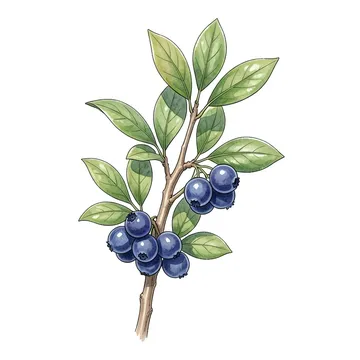
Blueberry companion plants are decided by one number: soil pH. The RHS gives blueberries a range of 4.5–5.5, and Clemson advises choosing another site if the pH is above 6.0. Most vegetables prefer pH 6–7, so the real incompatibility is chemistry, not pests.
No extension source we found endorses specific blueberry companions. Everything below is gardening practice, labeled Traditional, and judged mostly by whether a plant can live in acid soil without dragging the pH up.
Blueberry companion chart
Good companions
| Plant | Why | Evidence | |
|---|---|---|---|
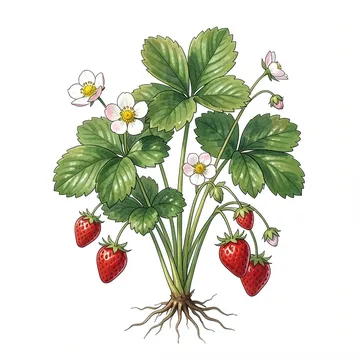
| Strawberry | Paired by gardeners, but strawberries want less acid soil than blueberries; compromise on pH. | Traditional | source |
| Borage | Borage is a bee magnet, and blueberries need bees; this pairing hasn't been trialed. | Traditional | source |
| Thyme | Creeping thyme makes a low ground cover around bushes, shading soil and limiting weeds. | Traditional | source |
Keep apart
| Plant | Why | Evidence | |
|---|---|---|---|
| Cabbage | Cabbage family crops want far higher soil pH than blueberries' 4.5–5.5 and can shade young bushes. | Traditional | source |
| Beans (bush & pole) | Beans like soil up to about pH 6.8; liming for them harms blueberries. | Traditional | source |
Proven Backed by a field trial or published study. Practical Recommended by a university extension or the RHS, with a clear reason. Traditional Gardener lore; no trial found yet.
What to Plant With Blueberries
- Borage — Traditional. A bee magnet, and blueberries rely on bee pollination. No trial has tested this exact pair, but the logic is straightforward.
- Thyme — Traditional. Gardeners use creeping thyme as a low ground cover around the bushes to shade the soil and limit weeds.
- Strawberry — Traditional. Often paired as a fellow berry, but strawberries prefer pH 5.8–6.2 according to UNH, so one plant will be slightly off its ideal.
The classic acid-loving partners, rhododendron, azalea and heathers, are ericaceous plants like blueberry. They fall outside the 50 crops in our chart, but they are the natural bedfellows if you are planting an ornamental border.
What Not to Plant With Blueberries
- Cabbage and other brassicas — Traditional. They want much higher soil pH than 4.5–5.5 and can shade young bushes.
- Beans and other legumes — Traditional. They prefer pH up to about 6.8. If you add lime to suit them, you harm the blueberries.
The general rule: any vegetable that needs lime, or that thrives around pH 6–7, belongs in a different bed. That covers most of the vegetable garden. If you want both, grow the blueberries in a separate acid bed or in containers.
This is also why blueberries rarely appear in vegetable companion charts. The pairings that work for a mixed vegetable bed, such as beans with cabbage-family crops, all assume near-neutral soil. A blueberry bush planted in the middle of that bed will either sit in the wrong pH or force you to manage two soils side by side, which is hard to do in one bed.
Blueberry Companion Planting and Soil pH
| Plant | Preferred pH | Sharing a bed with blueberries |
|---|---|---|
| Blueberry | 4.5–5.5 (RHS) | — |
| Strawberry | 5.8–6.2 (UNH) | Possible, with a compromise |
| Most vegetables | about 6–7 | Not recommended |
| Beans | up to about 6.8 | No |
There is a contradiction worth knowing. One gardening source says strawberries like pH around 5.4, close to blueberry range, but UNH Extension gives 5.8–6.2. We follow UNH. In practice, if you plant them together, set the bed for the blueberries and accept that the strawberries may yield a little less.
Test your soil before planting. If it reads above 6.0, Clemson's advice is to choose another site or grow in a raised bed or pots where you control the mix.
Pollination and Spacing
Grow two or more blueberry varieties for better cross-pollination, then add bee-friendly flowers nearby. Blueberry flowers are themselves pollinator-friendly, and borage on the edge of the planting adds more forage for honey bees and bumble bees.
For spacing, Clemson sets southern highbush 4–5 ft apart in the row with 8–10 ft between rows. The RHS gives 1–2 m depending on variety. Creeping thyme can carpet the gap under and between bushes without needing a different soil.
Free printable PDF
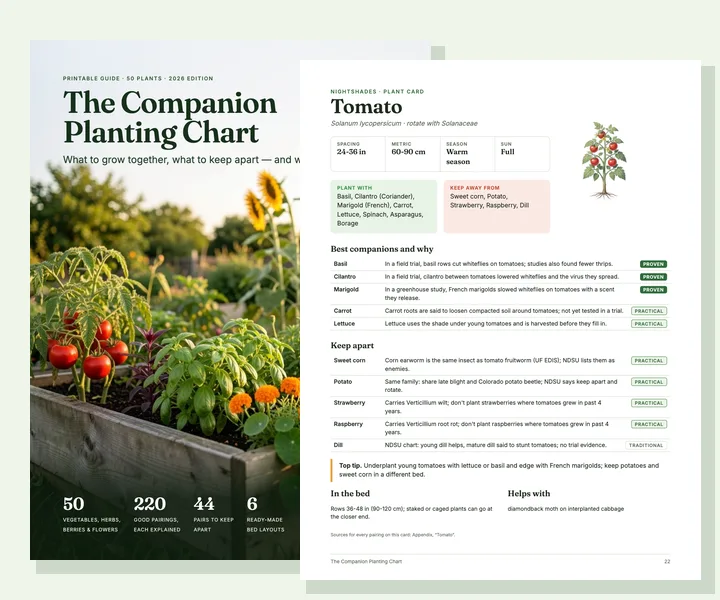
Get the complete companion planting chart
The PDF's blueberry card puts the pH range, spacing and acid-tolerant partners on one page you can take to the garden center when testing soil and choosing plants.
- 1-page fridge chart + full 50 × 50 matrix
- 50 plant cards with spacing and reasons
- 6 bed plans drawn to scale
- US Letter and A4
Blueberries in Pots Beside the Vegetable Garden
Containers solve the companion problem neatly. A blueberry in a pot of acid mix can sit at the end of a vegetable bed, close enough for the same bees to visit, while the vegetables grow in their own near-neutral soil. You get the pollinator overlap without the pH conflict.
If you go this route, still grow two or more varieties for cross-pollination, and keep a pot of borage or a strip of creeping thyme nearby for bees and ground cover.
Does It Really Work?
No trial has measured a yield or pest benefit from any blueberry companion. What is well established is the pH requirement, and that is why this page is mostly about which plants can live in acid soil. Borage for bees and thyme for ground cover are sensible additions; just do not expect them to replace correct soil.
Frequently asked questions
What vegetable grows well with blueberries?
Very few. Most vegetables prefer soil pH around 6–7, while blueberries need 4.5–5.5. Strawberries are the most common food crop paired with them, at the cost of a pH compromise. For vegetables, use a separate bed and keep the blueberries in their own acid soil or in containers.
Do blueberries like acidic soil?
Yes. The RHS gives a range of pH 4.5–5.5, and Clemson advises choosing another site if your soil is above 6.0. This is the main reason most vegetables make poor companions: they want less acidic soil, and liming for them would harm the blueberries.
What should not be planted near blueberry bushes?
Avoid cabbage-family crops and beans. Brassicas want much higher pH and can shade young bushes, and legumes prefer pH up to about 6.8. Any plant you would lime for belongs in a different bed, since lime raises pH in the root zone the blueberries share.
Should I plant two blueberry bushes together?
Yes, ideally two or more varieties. Growing at least two varieties improves cross-pollination. Clemson spaces southern highbush 4–5 ft apart in the row with 8–10 ft between rows, and the RHS suggests 1–2 m depending on variety.
What is a good ground cover for blueberries?
Creeping thyme is a common choice. Gardeners use it as a low cover around the bushes to shade the soil and limit weeds. It is a traditional pairing without trial data, but it stays low and does not compete for the bushes' light.