Guide
How to Plant a Pizza Garden
By the editorial team · Updated 2026-11-19 · Every pairing linked to its source
Quick answer. A pizza garden grows the toppings in one bed: tomatoes, peppers, onions, garlic, basil and oregano. Basil between the tomatoes is the strongest pairing; trials found the mix out-yielded either crop alone. Oregano makes a flowering edge, garlic fills the bed over winter, and potatoes and sweet corn stay somewhere else.
A pizza garden is a themed bed built around one meal, which makes it a favorite for families and first-time gardeners. Many people shape it like a pie, with a wedge for each topping.
The six classic plants also happen to make a reasonable companion group. Here is what each one brings, what the evidence says, and how to arrange them so nothing gets shaded out.
What goes in a pizza garden
- Tomato for the sauce.
- Pepper for topping.
- Onion and garlic.
- Basil for fresh leaves.
- Oregano, a perennial that comes back each year.
Tomatoes and peppers are both nightshades, so the bed rotates as a nightshade bed. Onion and garlic belong to the onion family, and basil and oregano are both mint-family herbs.
Which pizza garden pairs actually help
Tomato and basil (Proven). In West Virginia University garden trials, beds mixing tomato and basil out-yielded either crop grown alone by about 20%, because together they used the space more efficiently. Blind tasters in that study couldn't reliably tell the difference in flavor, so plant basil for the harvest, not to change the tomatoes. Separate research also found basil rows reduced whitefly on tomatoes in a Kenyan trial.
Oregano at the edge (Traditional). Oregon State and NDSU material lists oregano as a companion for tomatoes and peppers. There's no trial, but a flowering oregano edge draws bees and butterflies, and it marks the bed boundary for years.
Onion and garlic with tomato (Traditional). NDSU and UC charts list onions as tomato companions, and the UF/IFAS county chart lists garlic, without a tested mechanism. They are harmless neighbors.
Peppers with lettuce first (Practical). The University of Minnesota suggests sowing lettuce or spinach early and slotting pepper transplants between them as the greens are harvested. It's an easy way to get a salad from the pizza bed in spring.
Spacing each topping
| Plant | Spacing | Note |
|---|---|---|
| Tomato | 24-36 in (60-90 cm) | use the tighter figure for staked plants |
| Pepper | 12-24 in (30-60 cm) | rows about 36 in (90 cm) |
| Onion | 3-4 in (8-10 cm) | sets 1.5-2 in deep |
| Garlic | 6 in (15 cm) | cloves 1 in deep |
| Basil | 12 in (30 cm) | pinch tips for more leaves |
| Oregano | 8-12 in (20-30 cm) | spreads to 30-60 cm |
Tomatoes take most of the room. In a small bed, two or three staked tomatoes leave space for the rest.
Pizza garden layout
Round wedge bed. Divide a circle into slices. Put tomatoes in the two slices on the north side so they don't shade the rest, peppers next, then basil tucked against the tomato slices. Onions and garlic take the sunny south slices, and oregano runs around the outer rim.
Rectangular raised bed. Run tomatoes along the north edge with basil between and in front of them, peppers in the middle row, onions and garlic along the south edge, and oregano at one short end where it can stay year after year.
Timing. Garlic goes in the fall and grows over winter, so it overlaps little with the summer crops. Plant it in the onion slice; once you lift the bulbs, the gap can take another basil plant.
The garden layouts guide covers the general rules for placing tall crops and companions.
Keep these out of the pizza bed
- Potatoes. They share late blight and Colorado potato beetle with tomatoes and peppers. Even though potato wedges go well with pizza, give them their own bed.
- Sweet corn. Corn earworm is the same pest as tomato fruitworm.
- Beans and peas. Extension charts list the onion family as stunting legumes; basil appears as a bean foe in UF's chart as well.
- Fennel. UF, UC and NDSU charts list it as a bad tomato companion. That rating is Traditional, but there's no reason to risk it.
- Black walnut trees. Juglone injures tomatoes and peppers, so build the bed outside the tree's drip line (Purdue, UW).
If root-knot nematodes have damaged tomatoes before, grow a dense block of French marigolds in the bed for two months or more the season before, then dig them in (UF/IFAS).
Free printable PDF
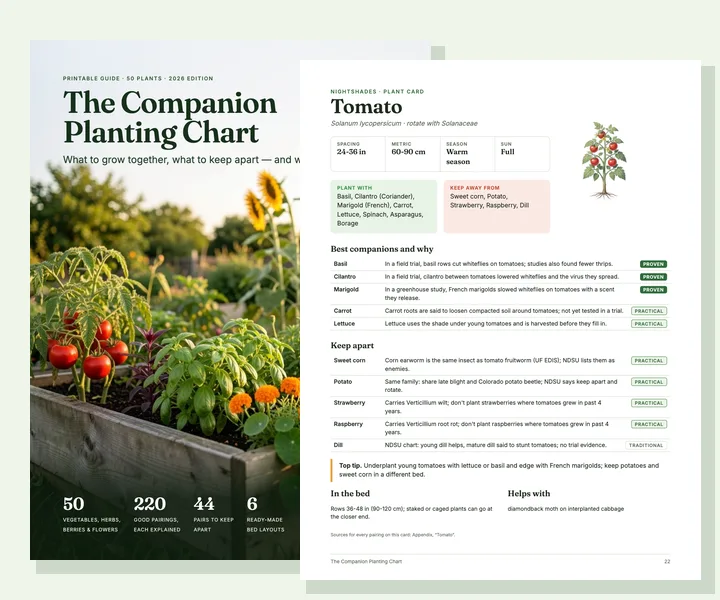
Get the complete companion planting chart
Print the pizza garden bed plan from the kit, drawn to scale with how many of each topping fit, and pin it next to your seed packets.
- 1-page fridge chart + full 50 × 50 matrix
- 50 plant cards with spacing and reasons
- 6 bed plans drawn to scale
- US Letter and A4
Frequently asked questions
What goes in a pizza garden?
The classic six are tomatoes, peppers, onions, garlic, basil and oregano. Some gardeners add other herbs, but those six cover the sauce and the main toppings. Tomato and basil are the best-supported pair: West Virginia University trials found the mix out-yielded either crop alone.
How big should a pizza garden be?
Size it around the tomatoes, which need 24-36 inches (60-90 cm) each. A bed with two or three staked tomatoes, a few peppers at 12-24 inches, a row of onions and garlic, three or four basil plants and one oregano clump fit comfortably and give you every topping from one bed.
Can tomatoes and peppers be planted together?
Yes, and most pizza gardens do. They are not foes in any of our sources. They are both nightshades, though, so they share diseases and should rotate together: move the whole pizza bed to a spot that hasn't grown tomatoes, peppers, eggplant or potatoes for three years.
Does basil make tomatoes taste better?
Probably not. Tasters at West Virginia University, working blind, did not consistently pick basil-grown tomatoes as better. The same trials did find the combined bed out-yielded either crop alone by about 20%, so basil still earns its place between the tomato plants.
Sources
- orgprints.org — 6614
- doi.org — agronomy6030042
- extension.oregonstate.edu — companion herbs flowers
- kenosha.extension.wisc.edu — Companion plants article
- mail.growables.org — CompanionGuideUF
- extension.umn.edu — companion planting home gardens
- ag.ndsu.edu — expect disease problems on potatoes and tomatoes
- extension.purdue.edu — ho 193
- hort.extension.wisc.edu — walnuttoxicity
- edis.ifas.ufl.edu — NG045