Guide
The Three Sisters Garden: Corn, Beans and Squash
By the editorial team · Updated 2026-11-19 · Every pairing linked to its source
Quick answer. A Three Sisters garden grows corn, climbing beans and winter squash or pumpkin together. Corn holds up the beans, beans fix nitrogen, and squash leaves shade the soil and smother weeds. Cornell trials found the trio produced more food energy and protein per area than single crops, but squash planted too close can cut bean yields.
The Three Sisters garden is the best-known companion planting system in North America, and one of the few with real research behind it. It also comes with history worth getting right.
This guide covers where the method comes from, what modern trials found, and how to space a home planting so all three sisters actually produce.
Where the Three Sisters come from
Corn, beans and squash were the main crops of many Indigenous peoples across North and Central America. Among them were the Haudenosaunee (Iroquois) and the Wendat (Huron) of the Northeast and Great Lakes, and peoples of the Southwest. In Mesoamerica the same crops grow together in the milpa system.
The name is rooted in Haudenosaunee tradition, which has its own words for the three sisters in Mohawk, Onondaga and Seneca. It is a food system and a cultural practice, not just a planting trick, and much of what we know about it comes from Indigenous farmers and scholars.
How the three crops share a bed
In the traditional Haudenosaunee method described by Cornell researcher Mt. Pleasant, corn and beans grow together in mounds, with soil hilled around the plants, and squash is planted between the mounds.
Each crop does a job:
- Corn grows tall and acts as a living pole for the beans.
- Beans climb the corn and fix nitrogen. Oregon State also notes that corn shade helps beans in hot summers and that their roots feed at different depths.
- Pumpkin or winter squash sprawls across the ground, shading the soil and suppressing weeds.
Minnesota Extension suggests the tall, mixed planting could confuse squash vine borer by sight, but nobody has tested it.
What the research found
Cornell (Proven): Mt. Pleasant's trials, which reproduced Haudenosaunee methods in New York, found the maize, bean and pumpkin intercrop gave more food energy and more protein per area than growing the same crops separately.
Iowa State (Proven, with a warning): trials there found squash so competitive that bean yields dropped. The mix still worked as a system, but beans lost out when squash had the upper hand.
Together those results say the system is productive, and that spacing decides whether the beans get their share.
Spacing a home Three Sisters planting
Squash is the sister that needs restraint. Winter squash and pumpkins want 48-60 inches (120-150 cm) per plant, with rows of 72-96 inches (180-240 cm) for vining types. Squeeze them in and they bury the beans.
A workable home layout:
- Corn hills or blocks. Set corn 8-12 inches (20-30 cm) apart within the planting.
- Pole beans at the corn. Plant pole beans 6-12 inches (15-30 cm) apart along the corn stalks.
- Squash between, not among. Put winter squash or pumpkin in the gaps between corn blocks, with the full 4-5 ft spacing, and steer vines outward.
All three are warm-season crops, so wait until your soil is warm enough for corn. Use pole beans, which climb; bush beans won't use the stalks. Pick a winter squash or pumpkin: summer squash such as zucchini is not one of the traditional sisters.
Good and bad neighbors for the Three Sisters
Good at the edges: nasturtium and marigold around the squash. A small Iowa study found both reduced squash bug and cucumber beetle damage. Lettuce grown in the shade of corn bolts later in summer.
Keep out: tomato. Corn earworm is the same insect as tomato fruitworm, and NDSU lists the two crops as enemies. Also keep sweet potato away from the squash, as both sprawl and the vines tangle. Onions and garlic belong in another bed too; extension charts commonly say they hold back beans.
For next year, the three sisters belong to three families, so plan where each one goes with the crop rotation guide.
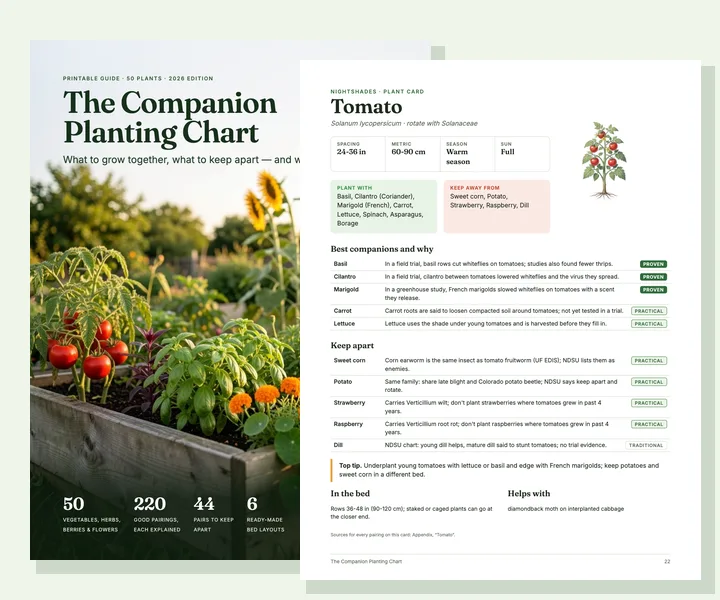
Free printable PDF
Get the complete companion planting chart
Print the Three Sisters bed plan from the kit, drawn to scale with corn, bean and squash counts, so the squash gets room without crowding out the beans.
- 1-page fridge chart + full 50 × 50 matrix
- 50 plant cards with spacing and reasons
- 6 bed plans drawn to scale
- US Letter and A4
Frequently asked questions
What is the Three Sisters method of gardening?
It is an Indigenous North American system of growing corn, climbing beans and squash together. Corn supports the beans, beans add nitrogen, and squash covers the soil to hold moisture and block weeds. Cornell trials found it produced more food energy and protein per area than the crops grown separately.
When should you start a Three Sisters garden?
After the danger of frost has passed and the soil has warmed, because corn, beans and squash are all warm-season crops. Plant them at the time your area normally sows sweet corn. A seasonal planting calendar for your region will give the date for your zone.
What is the best type of bean to grow in a Three Sisters garden?
A pole bean, because it climbs the corn stalks. Bush beans stay low and compete with the squash instead of using the corn as support. Space pole beans 6-12 inches (15-30 cm) apart along the corn, and keep onion-family crops out of the planting.
What grows well with the Three Sisters?
Nasturtiums and marigolds at the edges help with squash bugs and cucumber beetles, based on a small Iowa study. Lettuce can grow in the corn's shade. Avoid tomatoes, which share the corn earworm, and sweet potatoes, whose vines tangle with squash.
Sources
- ojs.ethnobiology.org — 721
- en.wikipedia.org — Three Sisters (agriculture)
- rhs.org.uk — companion planting
- extension.oregonstate.edu — companion planting
- extension.umn.edu — companion planting home gardens
- kenosha.extension.wisc.edu — Companion plants article
- harvesttotable.com — the best companion plants for sweet potatoes and what to avo