Squash family
Pumpkin Companion Plants: What to Grow With Pumpkins
By the editorial team · Updated 2026-11-19 · Every pairing linked to its source
Quick answer. The best pumpkin companion plants are corn and beans, the classic Three Sisters partners that out-yielded single crops in Cornell trials, plus nasturtiums and marigolds against squash bugs and cucumber beetles. Borage and radish are traditional extras. Keep pumpkins away from potatoes and sweet potatoes, and leave the beans enough room.
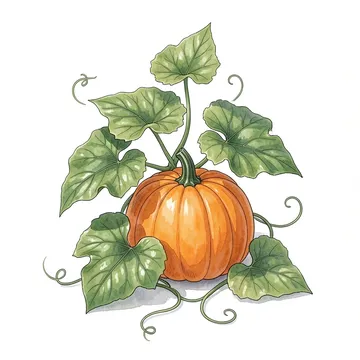
- Spacing
- 48-60 in · 120-150 cm
- Season
- Warm season
- Sun
- Full
- Rotate with
- Cucurbitaceae
Pumpkins are warm-season vines that need full sun, 48–60 in (120–150 cm) per plant and rows 72–90 in (180–230 cm) apart. A single plant can cover a small bed by midsummer, so whatever you grow alongside has to either stand above it or finish before it arrives.
Pumpkin has better companion evidence than most crops, because it was the squash used in Cornell's Three Sisters trials. Its main pest problems, squash bugs and cucumber beetles, also have studied companion responses.
Pumpkin companion chart
Good companions
| Plant | Why | Evidence | |
|---|---|---|---|
| Beans (bush & pole) | A Three Sisters partner that adds nitrogen; give beans room, as pumpkin can outcompete them. | Proven | source |
| Sweet corn | In trials, pumpkin sprawling under corn shaded out weeds; the mix out-yielded single crops. | Proven | source |
| Marigold (French) | In a farm study, a marigold border helped protect squash-family crops from squash bugs and beetles. | Proven | source |
| Nasturtium | In research, nasturtium reduced squash bugs and cucumber beetle damage on squash-family crops. | Proven | source |
| Oregano | Oregano is said to give pumpkins general pest protection; not trial-tested. | Traditional | source |
| Borage | A traditional pumpkin partner; borage flowers draw bees. | Traditional | source |
| Radish | A traditional pumpkin companion; no trial yet — worth a try. | Traditional | source |
Keep apart
| Plant | Why | Evidence | |
|---|---|---|---|
| Potato | Gardeners traditionally keep pumpkins away from potatoes; no reason has been shown. | Traditional | source |
| Sweet potato | Sweet potato and pumpkin vines both sprawl, tangling and crowding each other. | Traditional | source |
Proven Backed by a field trial or published study. Practical Recommended by a university extension or the RHS, with a clear reason. Traditional Gardener lore; no trial found yet.
What to Plant With Pumpkins
The Three Sisters
- Corn — Proven. Pumpkins sprawl under the corn, shading soil and weeds. In Cornell trials, the corn–bean–pumpkin combination out-yielded the same crops grown alone.
- Beans — Proven. Beans climb the corn and fix nitrogen. The caveat comes from Iowa State: squash can outcompete beans, so give them room.
Squash bug and beetle protection
- Nasturtium — Proven. Research cited by the University of Minnesota showed nasturtium reduced squash bugs; an Iowa study found less cucumber beetle damage too.
- Marigold — Proven. The Iowa study found marigolds helped reduce squash bug and cucumber beetle damage on cucurbits.
- Oregano — Practical. NDSU lists oregano as giving general pest protection to pumpkins. That's their claim; there's no trial.
Bees and early crops (Traditional)
What Not to Plant With Pumpkins
- Potato — Traditional. UC Davis and UF charts mark potato as incompatible with squash and pumpkin. No mechanism is recorded, but hilling potatoes beside spreading vines is awkward anyway.
- Sweet potato — Traditional. Both crops sprawl, and the vines tangle and crowd each other until harvest is a mess.
Also watch the beans in a Three Sisters bed. They're a friend, but Iowa State found squash competitive enough to cut bean yields. The fix is spacing rather than removing them.
Other squash-family crops (cucumbers, melons, zucchini and winter squash) share pests with pumpkins. Rotate them together and don't grow pumpkins where any of them grew last year.
What to Put Under Pumpkins While Growing
Pumpkins don't leave much space underneath once they run, so think in terms of timing. Early in spring, before the vines spread, radishes can use the bare ground around each pumpkin hill. Once the vines are out, the only real "under" planting is the Three Sisters arrangement, where pumpkin is the ground layer and corn and beans grow above it.
Keep the protective flowers—nasturtiums and marigolds—at the edges of the patch. Vines will grow over anything placed in their path.
Pumpkins in a Raised Bed
A standard raised bed is small for a pumpkin. With 48–60 in (120–150 cm) needed per plant, one pumpkin fills a 4 ft (120 cm) wide bed by itself. If you grow one there, let the vine trail out over the side onto a path or lawn, and use the bed edges for a border of nasturtiums or marigolds. For a Three Sisters planting, an in-ground plot works better than a raised bed. See garden layouts for bed sizes.
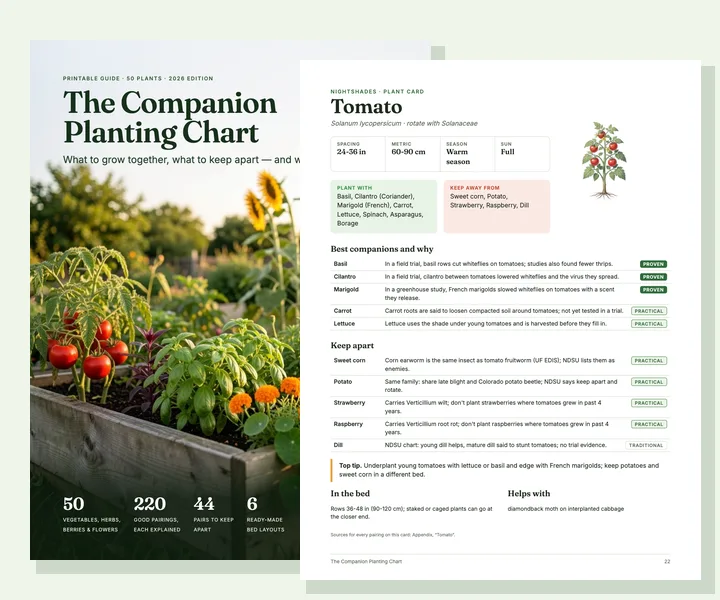
Free printable PDF
Get the complete companion planting chart
Download the PDF for the pumpkin card and the spacing sheet, so you can mark out every pumpkin hill before the corn and beans go in.
- 1-page fridge chart + full 50 × 50 matrix
- 50 plant cards with spacing and reasons
- 6 bed plans drawn to scale
- US Letter and A4
Pollinators in the Pumpkin Patch
Pumpkin flowers depend on bumblebees and other bees. Borage, which the Almanac lists with pumpkins, is the classic bee plant to add, and the marigolds and nasturtiums you grow for squash bugs give pollinators more reasons to stop by. Put the flowers along the patch edges or at the ends of rows, where the vines won't bury them by midsummer.
Does It Really Work?
For pumpkins, yes in two ways. The Three Sisters out-yielded monocultures in Cornell trials, and nasturtiums and marigolds reduced squash pests in other studies. The weak links are the beans, which can lose out to the pumpkin, and the traditional extras like borage and radish, which have no pumpkin trials.
Frequently asked questions
What should not be planted with pumpkins?
University charts list potatoes as incompatible with pumpkins, and sweet potatoes are a poor fit because both vines sprawl and tangle. Don't plant pumpkins where cucumbers, melons or other squash grew last year, since they share pests. In a Three Sisters bed, give beans enough room so the pumpkin doesn't crowd them out.
What to put under pumpkins while growing?
In early spring, radishes can use the soil around pumpkin hills and come out before the vines run. Later, the pumpkin itself becomes the ground cover, as in the Three Sisters system, where corn and beans grow above it. Keep nasturtiums and marigolds at the patch edges rather than under the vines.
Can I plant pumpkins near watermelon?
They are in the same family, so they share pests like cucumber beetles and should be rotated together. Neither is listed as a foe of the other in the charts we use, but both need 48–60 in (120–150 cm) per plant. Planted close, their vines will compete for the same ground.
Do pumpkins grow better on the ground or on a trellis?
Pumpkins are normally grown on the ground, and that's how they work as companions: in the Three Sisters system, the sprawling vines shade the soil and weeds beneath the corn. Plan 48–60 in (120–150 cm) per plant and rows 72–90 in (180–230 cm) apart for in-ground growing.
What are the Three Sisters plants?
The Three Sisters are corn, beans and a sprawling squash such as pumpkin. Corn gives the beans something to climb, beans fix nitrogen, and the pumpkin shades the soil. Cornell trials found the combination out-yielded the same crops grown alone, though Iowa State found the squash can crowd out the beans.