Guide
Plants Not to Grow Together
By the editorial team · Updated 2026-11-19 · Every pairing linked to its source
Quick answer. The vegetable pairs to keep apart with the strongest reasons are tomato and potato (shared late blight), tomato and sweet corn (corn earworm attacks both), and any nightshade before strawberries or raspberries (Verticillium wilt). Black walnut trees harm tomatoes, peppers and potatoes through juglone. Many other foe pairs come only from old charts.
Knowing which plants not to grow together saves more harvests than any list of friends. A missing companion costs you a small bonus; a bad neighbor can bring a disease that takes out both crops.
This guide sorts every foe pair in our 50-plant chart by its reason, from documented disease to plain chart lore, and ends with allelopathy: plants that release compounds that harm their neighbors.
Shared disease: the firmest rules
- Tomato and potato. Same family; they share late blight and Colorado potato beetle, and NDSU says blight in one spreads to the other. Keep them in different beds and rotate the whole nightshade family.
- Nightshades before strawberry. Tomatoes, potatoes, peppers and eggplant carry Verticillium wilt. The recommended wait is 4 years after tomatoes according to UNH, and Georgia says 5.
- Nightshades before raspberry. The same disease causes Verticillium root rot. UMaine advises 4 years, Illinois 5.
- Strawberry and raspberry. Illinois puts strawberries on its list of crops raspberries shouldn't follow, so the two berries need separate ground.
These are rated Practical: extension services name a clear mechanism, even without a companion-planting trial.
Shared pests
- Tomato and sweet corn. UF EDIS confirms one caterpillar feeds on both, called corn earworm on the cob and tomato fruitworm on the vine; NDSU lists the crops as enemies.
- Carrot with celery or dill. All three are in the carrot family (Apiaceae) and share carrot fly. UF lists celery as bad for carrots; UC Davis and UF list dill. Dill and carrot can also cross-pollinate if you save seed.
- Celery and parsley. Same family again; the UF chart keeps them apart.
- Squash and okra. Garden-blog advice says both build up root-knot nematodes. Traditional, but worth noting if nematodes are already a problem.
Soil pH and space
- Blueberry with cabbage or beans. Blueberries need pH 4.5-5.5. Cabbage-family crops need soil that is far less acidic, and beans and peas like it near 6.8; whatever lime you add for them works against the blueberries.
- Sweet potato with pumpkin or winter squash. All three sprawl, and the vines tangle and crowd each other, making harvest hard.
Neither pair is chemically hostile. They simply want conditions the other can't share.
Chart lore: Traditional foe pairs
These appear in UC Davis, UF/IFAS or NDSU charts without a tested mechanism. Following them costs little, but don't treat them as proven:
- Onion family with beans and peas. Onion, garlic and chives are said to stunt legumes. This is the most consistent rule across charts, though no trial was found.
- Potato with cucurbits. UC Davis and UF list cucumber, squash, pumpkin, zucchini and melons as incompatible.
- Sage with cucumber and onion. NDSU calls sage generally injurious to cucumber.
- Basil with beans. The UF chart says so, while popular lore says the opposite.
- Mature dill with tomato. NDSU says young dill helps and mature dill stunts tomatoes.
- Asparagus with onion. Listed in the UF chart.
- Strawberry with the cabbage family. Listed by UF, UC and WVU.
- Sunflower with rhubarb. UK garden guides say sunflowers harbor rhubarb curculio; unverified.
Allelopathic plants: black walnut, sunflower and fennel
Allelopathy means a plant releases compounds that hold back the growth or germination of others. Three names come up in vegetable gardens, with very different levels of evidence.
Black walnut. This is the case extension services take seriously. The tree produces juglone, and Purdue and UW-Extension report it injures tomatoes, peppers, eggplant and potatoes, and affects cabbage, asparagus and rhubarb. Site vegetable beds outside the tree's drip line.
Sunflower. In lab studies, sunflower tissues and residues inhibit germination and early growth of many species. Field data for garden vegetables is thin. The practical step: pull stalks and roots at season end instead of tilling them in before sowing small seeds. UC, UF, WVU and Arizona Extension material lists sunflower as bad for potatoes on allelopathy grounds, but potato-specific harm hasn't been shown.
Fennel. UF, UC and NDSU charts all list it as a bad tomato companion, and UF or UC charts add beans, potatoes and eggplant. Our sources give no mechanism and no trial, so we rate it Traditional. Grow it in its own corner if you grow it at all.
Every pair to keep apart
| Pair | Why | Evidence |
|---|---|---|
| Tomato + Sweet corn | Corn earworm also attacks tomatoes as tomato fruitworm; keep the two crops apart. | Practical |
| Tomato + Potato | Potatoes share late blight and Colorado potato beetle with tomatoes; keep them apart and rotate. | Practical |
| Tomato + Strawberry | Tomatoes carry Verticillium wilt; don't plant strawberries where tomatoes grew in the past four years. | Practical |
| Tomato + Raspberry | Tomatoes carry Verticillium; don't plant raspberries where tomatoes grew in the past four years. | Practical |
| Tomato + Dill | Young dill is said to help, but mature dill may stunt tomatoes; untested. | Traditional |
| Pepper + Strawberry | Peppers host Verticillium; avoid planting strawberries where peppers recently grew. | Practical |
| Pepper + Raspberry | Peppers host Verticillium; avoid planting raspberries where peppers recently grew. | Practical |
| Eggplant + Strawberry | Eggplant hosts Verticillium; avoid planting strawberries where eggplant recently grew. | Practical |
| Eggplant + Raspberry | Eggplant hosts Verticillium; leave a five-year gap before planting raspberries there. | Practical |
| Potato + Strawberry | Potatoes host Verticillium; keep strawberries off ground where potatoes grew. | Practical |
| Potato + Raspberry | Potatoes host Verticillium; keep raspberries off former potato ground for four to five years. | Practical |
| Potato + Cantaloupe | Traditionally kept away from potatoes; no reason documented, so it is a cautious choice. | Traditional |
| Potato + Cucumber | Gardeners have long kept cucumbers away from potatoes; no known reason, but easy to separate. | Traditional |
| Potato + Pumpkin | Gardeners traditionally keep pumpkins away from potatoes; the reason has never been shown. | Traditional |
| Potato + Sunflower | Sunflowers are said to hold back potatoes; that effect hasn't been shown for potatoes. | Traditional |
| Potato + Watermelon | Traditionally kept apart from potatoes; no reason documented, so space them if you can. | Traditional |
| Potato + Winter squash | A traditional warning keeps winter squash away from potatoes; no mechanism is known. | Traditional |
| Potato + Zucchini | Long called a poor potato neighbor; no known reason, so plant apart to be safe. | Traditional |
| Cucumber + Sage | Sage has long been called harmful to cucumbers; no trial yet, so play it safe. | Traditional |
| Zucchini + Okra | Squash and okra both build up root-knot nematodes, so avoid planting them together. | Traditional |
| Winter squash + Okra | Squash and okra both build up root-knot nematodes; keep them apart. | Traditional |
| Winter squash + Sweet potato | Both vines sprawl; they tangle and crowd each other. | Traditional |
| Pumpkin + Sweet potato | Sweet potato and pumpkin vines both sprawl, tangling and crowding each other. | Traditional |
| Beans + Basil | Gardening tradition says basil is bad for bush and pole beans; no trial yet. | Traditional |
| Beans + Chives | Tradition holds the onion family holds beans back; no trial has shown it. | Traditional |
| Beans + Garlic | Garlic is said to stunt beans; an old warning, not trial-tested. | Traditional |
| Beans + Onion | Onions are said to stunt beans; a long-standing warning with no trial behind it. | Traditional |
| Beans + Blueberry | Beans prefer soil up to about pH 6.8; liming for them harms blueberries. | Traditional |
| Peas + Chives | Tradition keeps the whole onion family away from peas; no trial has shown harm. | Traditional |
| Peas + Garlic | Garlic is traditionally kept away from peas; the reason has never been tested. | Traditional |
| Peas + Onion | Gardeners have long warned against onions near peas; untested, but easy to avoid. | Traditional |
| Broccoli + Strawberry | Tradition keeps strawberries away from the cabbage family; no trial behind it. | Traditional |
| Cabbage + Strawberry | Strawberries are traditionally kept away from cabbage; no trial has tested this. | Traditional |
| Cabbage + Blueberry | Cabbage wants much higher soil pH than blueberries' 4.5–5.5 and can shade young bushes. | Traditional |
| Kale + Strawberry | Gardening tradition says strawberries and kale don't mix; the reason is untested. | Traditional |
| Cauliflower + Strawberry | Strawberries are an old no-go beside cauliflower; untested, but easy to avoid. | Traditional |
| Brussels sprouts + Strawberry | Tradition keeps strawberries out of Brussels sprouts beds; no trial behind it. | Traditional |
| Onion + Asparagus | Tradition keeps asparagus away from onions; no reason has been documented. | Traditional |
| Onion + Sage | Tradition calls sage a poor onion neighbor; no reason is known. | Traditional |
| Carrot + Celery | Celery is in the carrot family and shares carrot fly and diseases. | Traditional |
| Carrot + Dill | Dill is in the carrot family and can cross-pollinate with carrots grown for seed. | Traditional |
| Celery + Parsley | Parsley is in the same family as celery and shares its pests. | Traditional |
| Rhubarb + Sunflower | Sunflowers are said to harbor the rhubarb curculio; unverified, but easy to avoid. | Traditional |
| Strawberry + Raspberry | Strawberries host Verticillium, so avoid them where raspberries will go. | Practical |
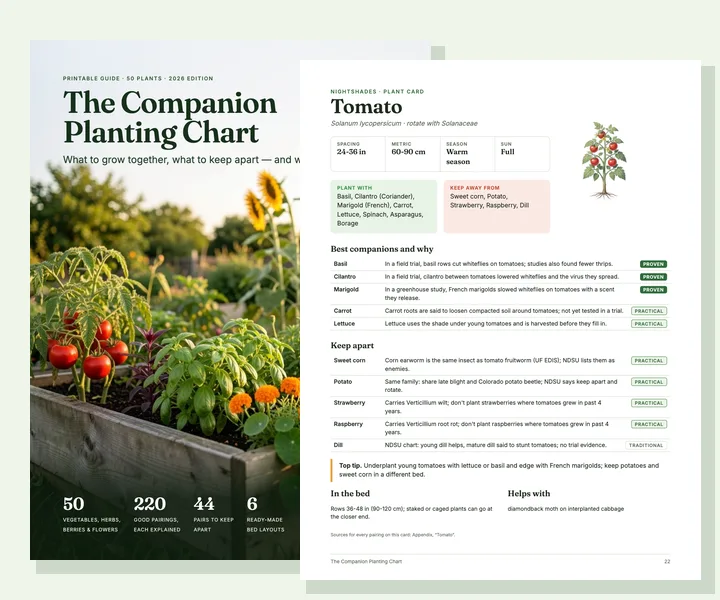
Free printable PDF
Get the complete companion planting chart
Print the never-together sheet from the kit: every foe pair on one page with its reason, ready to check before you plant out each bed.
- 1-page fridge chart + full 50 × 50 matrix
- 50 plant cards with spacing and reasons
- 6 bed plans drawn to scale
- US Letter and A4
Frequently asked questions
What is allelopathy?
Allelopathy is when a plant releases chemicals, through roots, leaves or decaying residue, that suppress the germination or growth of nearby plants. In home vegetable gardens the best-documented example is black walnut, whose juglone injures tomatoes, peppers, potatoes and several other crops. Sunflower residues show the effect in lab studies.
Is fennel allelopathic?
It is often described that way, and extension charts list fennel as a poor companion for tomatoes, with some adding beans, potatoes and eggplant. None of the sources behind our chart give a mechanism or a trial, so we label it Traditional. Keeping fennel in a separate spot is a cautious, low-cost choice.
What is the most allelopathic plant for vegetable gardeners?
Black walnut is the one extension services warn home gardeners about. Purdue and UW-Extension both report that its juglone injures tomatoes, peppers, eggplant and potatoes, and affects cabbage, asparagus and rhubarb. Keep vegetable beds outside the tree's drip line rather than relying on companions to compensate.
What should never be planted near tomatoes?
Potatoes, because they share late blight and Colorado potato beetle, and sweet corn, because corn earworm also attacks tomato fruit. Avoid planting near black walnut. Charts also list fennel and kohlrabi as poor tomato companions, though those ratings come from lore rather than trials.
Sources
- ag.ndsu.edu — expect disease problems on potatoes and tomatoes
- extension.unh.edu — growing fruit strawberries fact sheet
- extension.umaine.edu — 2066e
- extension.illinois.edu — growing raspberries
- kenosha.extension.wisc.edu — Companion plants article
- mail.growables.org — CompanionGuideUF
- class.ucanr.edu — 301140
- ucanr.edu — 388577
- epicgardening.com — okra companion plants
- morningchores.com — blueberry companion plants
- harvesttotable.com — the best companion plants for sweet potatoes and what to avo
- growing-guides.co.uk — companion planting rhubarb
- extension.purdue.edu — ho 193
- hort.extension.wisc.edu — walnuttoxicity