Herbs
Chives Companion Plants
By the editorial team · Updated 2026-11-19 · Every pairing linked to its source
Quick answer. Chives companion plants include carrots, tomatoes, cabbage-family crops, strawberries and raspberries. Keep chives out of bean and pea rows: UC, WVU and NDSU charts all list the onion family as stunting legumes. Chives are perennial, tolerate part shade, and should be deadheaded to stop self-seeding.
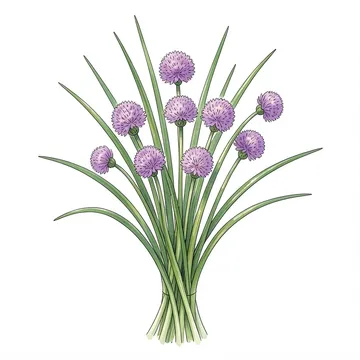
- Spacing
- 6-8 in · 15-20 cm
- Season
- Perennial
- Sun
- Partial
- Rotate with
- Amaryllidaceae (Allium)
Chives companion plants follow the onion-family rules, in miniature. Chives are a perennial allium that forms neat clumps, tolerates part shade and flowers in a way bees appreciate. That makes them an easy edging for beds of carrots, tomatoes or brassicas.
The same family ties bring the one clear warning. Several extension sources list onion-family plants as bad neighbors for beans and peas. None explains why, and none cites a trial, but the advice is consistent enough to follow.
Chives companion chart
Good companions
| Plant | Why | Evidence | |
|---|---|---|---|
| Carrot | A traditional pairing; chives may distract carrot rust fly. | Traditional | source |
| Tomato | Chives are a favorite tomato companion in many guides; no trial yet. | Traditional | source |
| Cabbage | Cabbage is traditionally said to do better near chives, which may distract cabbage maggots. | Traditional | source |
| Strawberry | Strawberries are a traditional chives partner; untested — worth a try. | Traditional | source |
| Raspberry | Chives' scent is said to confuse aphids and beetles; keep them out of the canes. | Traditional | source |
Keep apart
| Plant | Why | Evidence | |
|---|---|---|---|
| Beans (bush & pole) | Tradition says the onion family stunts beans; no trial has shown it. | Traditional | source |
| Peas | Tradition keeps the onion family away from English peas; untested. | Traditional | source |
Proven Backed by a field trial or published study. Practical Recommended by a university extension or the RHS, with a clear reason. Traditional Gardener lore; no trial found yet.
What to Plant With Chives
Vegetables
- Carrot — Traditional. Listed by UF and Oregon State; Oregon State says chives may distract carrot rust fly.
- Tomato — Traditional. Listed in the UF chart, the Oregon State sheet and the NDSU list.
- Cabbage — Traditional. Oregon State lists chives as enhancing cole crops and possibly distracting cabbage maggot.
Berries
- Strawberry — Traditional. UF and WVU list the onion family with strawberries.
- Raspberry — Traditional. Allium scent is said to confuse aphids and beetles; keep chives from spreading into the canes.
Chives are narrow and upright, so they fit along the edge of these beds without shading the crop.
What Not to Plant With Chives
- Beans — Traditional. UC Davis, WVU and NDSU charts say the onion family stunts beans.
- Peas — Traditional. The UC chart lists the onion family as incompatible with English peas.
This onion-versus-legume conflict appears across UC, WVU, NDSU and Arizona Extension material, but none of them cites the evidence behind it. Treat it as a cautious rule: keep chives out of bean and pea rows, and put legumes in a bed edged with something else.
Chives Companion Plants as Bed Edging
The top tip from our sources is to edge carrot or tomato beds with chives. A simple pattern:
| Plant | Spacing | Position |
|---|---|---|
| Chives | clumps at least 15 cm (6 in) apart (RHS); 5 in (Texas A&M) | Bed edge |
| Carrot | 1–2 in (2.5–5 cm) | Inner rows |
| Tomato | 24–36 in (60–90 cm) | Center |
Because chives are perennial, an edging planted once can stay for years while the carrots or tomatoes inside rotate. Plan the rotation so that beans and peas never land in the bed the chives frame.
Oregon State also says chives may reduce or inhibit mildew. No trial is cited, so do not count on it.
Keeping Chives in Bounds
Chives flower readily, and the blooms attract bees and other pollinators. Left alone, though, the flowers set seed and chives self-seed into the bed. Deadhead after flowering to keep the clumps where you planted them. In a raspberry patch especially, stray seedlings can creep into the canes and become hard to weed out.
Chives also tolerate part shade, according to Texas A&M, which means they can edge the shadier side of a tall tomato row without sulking.
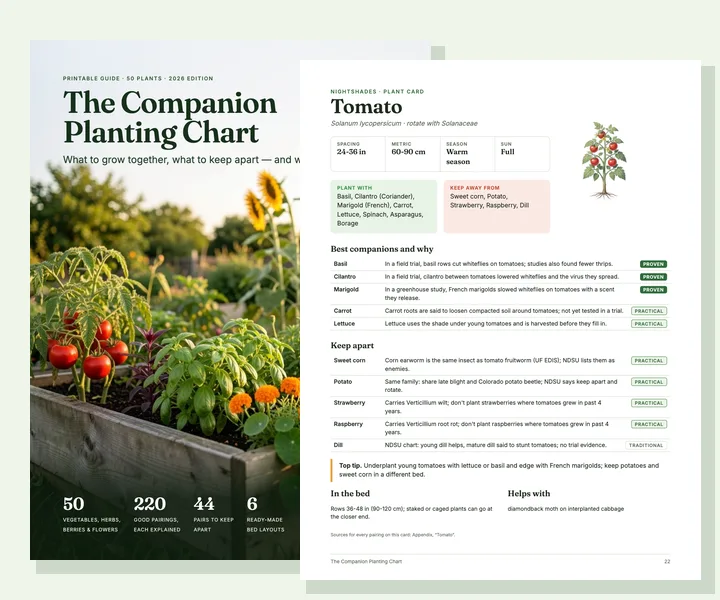
Free printable PDF
Get the complete companion planting chart
The PDF's never-together sheet shows the onion family against beans and peas, and the bed plans place chives edging where legumes never follow.
- 1-page fridge chart + full 50 × 50 matrix
- 50 plant cards with spacing and reasons
- 6 bed plans drawn to scale
- US Letter and A4
Chives Companion Planting Chart
| Plant | With chives? | What sources say | Label |
|---|---|---|---|
| Carrot | Yes | May distract carrot rust fly (Oregon State) | Traditional |
| Tomato | Yes | UF, Oregon State, NDSU listings | Traditional |
| Cabbage | Yes | May distract cabbage maggot | Traditional |
| Strawberry | Yes | Onion family listed by UF and WVU | Traditional |
| Raspberry | Yes | Edge only; keep out of the canes | Traditional |
| Beans | No | Onion family said to stunt them | Traditional |
| Peas | No | Listed incompatible by UC | Traditional |
Chives belong to the same family as onion and garlic, so the same companions and the same legume warning apply across all three. If you already keep alliums out of your bean bed, chives simply follow that rule. In a rotation plan, count chives with the alliums even though they are perennial and stay in one place: the beds they edge are the beds where legumes should not land.
Does It Really Work?
Every chives pairing is a chart listing, with pest claims about carrot fly and cabbage maggot that no trial has checked. The warning about beans and peas is consistent across sources but equally untested. Plant chives as a tidy, bee-friendly edging for carrots, tomatoes and brassicas, and keep the legumes elsewhere to be safe.
Frequently asked questions
What not to grow chives with?
Keep chives away from beans and peas. UC Davis, WVU and NDSU charts list the onion family as stunting beans, and UC lists it as incompatible with English peas. No source cites a trial, but the advice is consistent across several extension services.
Do chives spread?
Chives form clumps and also self-seed if the flowers are left to set seed. The RHS and Texas A&M recommend deadheading to stop that. Near raspberries in particular, keep chives from spreading into the canes, where seedlings are hard to remove.
How far apart should I plant chives?
The RHS suggests clumps at least 15 cm (6 in) apart, and Texas A&M gives about 5 in. That spacing suits an edging row along a carrot, tomato or strawberry bed, leaving room for each clump to fill out.
What vegetables grow well with chives?
Carrots, tomatoes and cabbage-family crops are listed as chives companions by UF, Oregon State and NDSU. Strawberries and raspberries also appear in some charts. These are traditional pairings without trial evidence, but chives are narrow enough to edge these beds easily.
Can chives grow in partial shade?
Yes. Texas A&M notes that chives tolerate part shade, which sets them apart from many sun-loving herbs. That lets you use them along the shady side of a tall tomato row or near taller crops without losing the edging.