Berries
Raspberry Companion Plants
By the editorial team · Updated 2026-11-19 · Every pairing linked to its source
Quick answer. Raspberry companion plants belong along the row edge, not under the canes: garlic is the one with an extension listing, and chives, thyme, marigold and nasturtium are traditional choices. More important is the site. Do not plant raspberries where tomatoes, potatoes, peppers, eggplant or strawberries grew in the past 4–5 years.
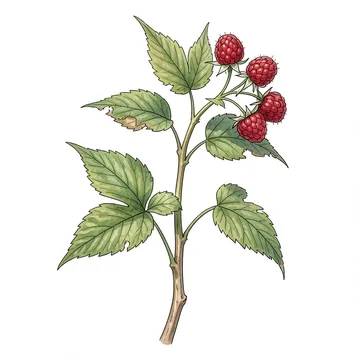
- Spacing
- 16-24 in · 40-60 cm
- Season
- Perennial
- Sun
- Full
- Rotate with
- Rosaceae
Raspberry companion plants are a smaller question than raspberry siting. The patch will stand for years, and the soil you choose decides whether it starts with Verticillium wilt already waiting. University of Maine and Illinois Extension both treat this as the first step.
Once the site is right, companions go along the edges of the row. The RHS advises against planting under the canes, so think of herbs and flowers as a border strip. Only one of these pairings, garlic, comes from an institutional chart; the rest are gardening tradition.
Raspberry companion chart
Good companions
| Plant | Why | Evidence | |
|---|---|---|---|
| Garlic | Raspberries are paired with garlic to help fend off Japanese beetles and aphids. | Practical | source |
| Chives | Chives' scent is said to confuse aphids and beetles; keep them from spreading into canes. | Traditional | source |
| Marigold (French) | French marigold edging is said to deter pests and draw pollinators; untested on raspberries. | Traditional | source |
| Nasturtium | Nasturtium is said to draw pollinators and predatory insects to the patch; anecdotal. | Traditional | source |
| Thyme | Low thyme along the row edge is said to mask the canes from pests; no trial. | Traditional | source |
Keep apart
| Plant | Why | Evidence | |
|---|---|---|---|
| Tomato | Raspberries can catch Verticillium root rot where tomatoes grew; wait four years before planting. | Practical | source |
| Potato | Raspberries can catch Verticillium where potatoes grew; wait four to five years. | Practical | source |
| Pepper | Raspberries can pick up Verticillium where peppers grew; choose fresh ground for canes. | Practical | source |
| Eggplant | Raspberries are at risk of Verticillium where eggplant grew; wait five years. | Practical | source |
| Strawberry | Strawberries host Verticillium; avoid planting raspberries where strawberries grew. | Practical | source |
Proven Backed by a field trial or published study. Practical Recommended by a university extension or the RHS, with a clear reason. Traditional Gardener lore; no trial found yet.
What to Plant With Raspberries
- Garlic — Practical. A herb companion chart credited to the Texas Agricultural Extension Service lists garlic for raspberries, against Japanese beetles and aphids. It is the only institutional pairing we found.
- Chives — Traditional. Allium scent is said to confuse aphids and beetles. Keep chives from creeping into the canes.
- Thyme — Traditional. A low aromatic herb along the row edge; claimed to mask the crop's scent, with no trial.
- Marigold — Traditional. French marigold edging is said to deter pests and draw pollinators; untested on raspberries.
- Nasturtium — Traditional. Said to bring pollinators and predatory insects to the patch; anecdotal.
Raspberry flowers need insect pollination, so flowering companions near the patch have a clear purpose even if their pest claims are unproven.
All five companions are short or narrow, which suits the RHS advice to keep plants out from under the canes. Garlic and chives are upright and take a thin strip; thyme stays low; marigold and nasturtium can be swapped each year, so the edging does not become a permanent tangle you have to weed around.
What Not to Plant With Raspberries
All five warnings here are Practical: they come from extension services and are about Verticillium wilt, a soil disease.
- Tomato — carries Verticillium. Avoid ground where tomatoes grew in the last 4 years.
- Potato — a Verticillium host; keep raspberries off former potato ground for 4–5 years.
- Pepper — a host; avoid recent pepper ground.
- Eggplant — a host; Illinois advises a 5-year gap.
- Strawberry — Illinois Extension lists strawberries among the hosts to avoid before raspberries.
The University of Maine gives a 4-year gap after nightshades; Illinois says 5 and adds strawberries. Using the longer gap is the safer choice.
Choosing a Site for the Raspberry Patch
Verticillium in the soil cannot be fixed with sprays, so site choice is the companion decision that counts most.
- Check your garden records for tomatoes, potatoes, peppers, eggplant and strawberries over the last 5 years.
- Pick ground that has had none of them.
- Test pH: the University of Maine gives 5.6–6.2 for raspberries.
- Plan the companion strip along the outside of the row, not under the canes.
| Source | Plant spacing | Row spacing |
|---|---|---|
| RHS | 40–60 cm (16–24 in) | 1.5–2 m |
| University of Maine | crowns about 2 ft (60 cm) | 8–12 ft |
The wide rows leave plenty of room for a border of garlic, chives or thyme that you can reach without wading into the canes.
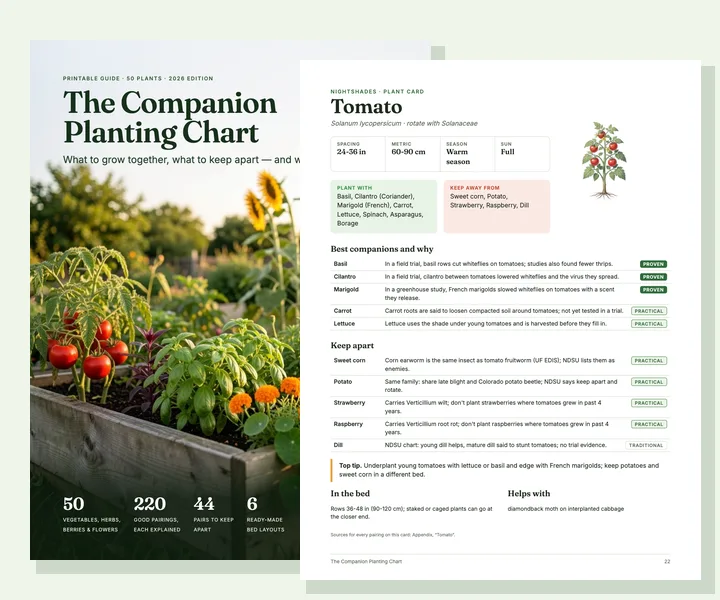
Free printable PDF
Get the complete companion planting chart
The PDF's rotation sheet and raspberry card help you track five years of nightshades so you can pick clean ground for the patch before buying canes.
- 1-page fridge chart + full 50 × 50 matrix
- 50 plant cards with spacing and reasons
- 6 bed plans drawn to scale
- US Letter and A4
Raspberry Companion Plants as a Border Strip
Think of the companions as a strip about the width of a path along each side of the row. Within it:
| Companion | Spacing | Why there |
|---|---|---|
| Garlic | 6 in (15 cm) | Chart-listed for beetles and aphids |
| Chives | 6–8 in (15–20 cm) | Allium scent; deadhead to stop self-seeding |
| Thyme | 8–12 in (20–30 cm) | Low edge plant, needs sharp drainage |
| French marigold | 8–10 in (20–25 cm) | Pollinators, annual edging |
| Nasturtium | 10–12 in (25–30 cm) | Pollinators and predatory insects |
Keeping the strip clear of the cane base also stops chives or nasturtiums from becoming a weed problem inside the patch. Raspberries want full sun, so leave taller plants out of the strip altogether.
Does It Really Work?
The pest claims for raspberry companions are mostly blog lore, and garlic is the only one with an extension listing behind it. The site rules are on firmer ground: Verticillium is a documented problem, and extension services agree on a multi-year gap. Plant the patch on clean soil first, then add a flowering edge for pollinators.
Frequently asked questions
What should not be planted near raspberries?
Do not plant raspberries where tomatoes, potatoes, peppers, eggplant or strawberries grew in the past 4–5 years. All of them host Verticillium wilt, a soil disease that sprays cannot fix. University of Maine gives a 4-year gap after nightshades and Illinois Extension recommends 5 years.
What is a good ground cover for raspberries?
The RHS advises not planting under the canes at all, so skip a true ground cover there. Instead, use a low border along the row edge. Thyme is a traditional choice for that strip, and garlic or chives also fit without crowding the canes.
Can rhubarb be planted near raspberries?
Neither crop's companion data lists the other as a friend or a foe. Both are long-lived perennials that want full sun. If they share an area, keep enough distance that spreading canes stay out of the rhubarb's space, and leave access paths for picking.
What are the best companion plants for raspberries?
Garlic is the only raspberry companion listed by an extension-credited chart, for Japanese beetles and aphids. Chives, thyme, French marigold and nasturtium are traditional choices that bring pollinators or aromatic edging. Plant them along the row edge rather than under the canes.
How far apart should raspberries be planted?
The RHS spaces raspberries 40–60 cm (16–24 in) apart with rows 1.5–2 m apart. The University of Maine suggests crowns about 2 ft apart with rows 8–12 ft apart. Those wide rows leave room for a strip of companion herbs on each side.