Plant group
Berry Companion Planting
By the editorial team · Updated 2026-11-19 · Every pairing linked to its source
Quick answer. With berries, the ground matters more than the neighbors. Strawberries and raspberries need ground free of nightshade crops for 4-5 years, because those crops leave Verticillium wilt. Blueberries need soil pH 4.5-5.5, which rules out most vegetables. Borage beside strawberries is the one companion with trial support.
Choose a plant
Berries
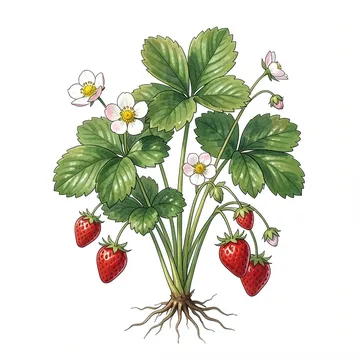
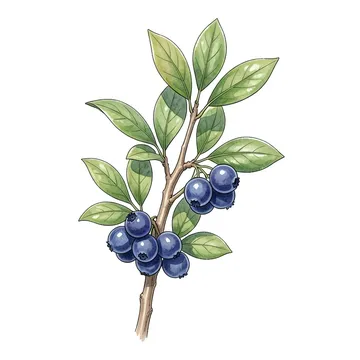
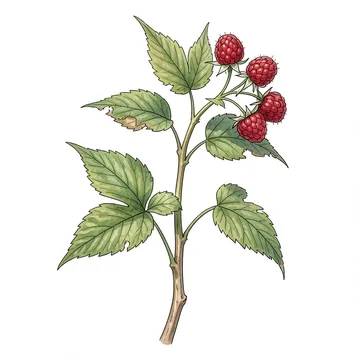
Berry companion planting starts below ground. Strawberries, blueberries and raspberries stay in one spot for years, so two questions come before any companion: what grew in that soil before, and what pH does the berry need?
Get those right and the companion choices become simple. Get them wrong and no flower or herb will rescue the planting.
Two families, very different soils
Rose family (Rosaceae): strawberry and raspberry. Both are badly hurt by Verticillium wilt, a soil disease carried by the nightshades. For strawberries the wait after tomatoes is 4 years at UNH and 5 in Georgia guidance. For raspberries, UMaine says 4 years after nightshades, and Illinois says 5 and adds strawberries to the list. The safest site has never, as far as you know, grown a nightshade.
The two berries also differ slightly in pH: UNH gives 5.8-6.2 for strawberries and UMaine gives 5.6-6.2 for raspberries.
Heath family (Ericaceae): blueberry. It wants pH 4.5-5.5 (RHS), and Clemson advises choosing another site if pH is above 6.0. Most vegetables in our chart prefer roughly 6-7. That gap, rather than any chemical rivalry between plants, is the real reason blueberries don't share vegetable beds.
Strawberry companions
Proven: borage. In a 2020 study by Griffiths-Lee, Nicholls and Goulson in British gardens, the borage-side strawberry plants set roughly a third more berries, which were also heavier, and flies visited them more often. A University of Minnesota trial found a borage strip at the row end drew mostly honey bees and bumble bees, with preliminary signs of heavier berries nearby. It is one strong study plus one preliminary one, so promising rather than settled.
Traditional foes: the cabbage family. UF, UC and WVU charts list cabbage, broccoli, kale, cauliflower and Brussels sprouts as poor strawberry neighbors, without a stated mechanism.
Keep apart: strawberries and raspberries. Illinois Extension warns against putting raspberries where strawberries were, since both suffer from Verticillium; separate beds solve it.
Blueberry and raspberry companions
Blueberry: no extension source we found endorses specific companions, so every pairing you read online is lore. The documented conflicts are about pH: cabbage-family crops grow best in far less acidic soil and may shade small bushes, while legumes such as beans like pH near 6.8, and the lime they need is bad news for blueberries. The useful partner is another blueberry: grow two or more varieties for better cross-pollination. If you want strawberries nearby, note that sources disagree on strawberry pH, so sharing a bed means a compromise for one of them.
Raspberry: the only institutional companion claim we found is garlic, from the UF/IFAS herb chart credited to the Texas Agricultural Extension Service. Flowering companions should go near the canes, not under them (RHS), because raspberries need bees and the canes need open ground. Leave the tomato family out of that ground for years.
Planning a berry bed
Because these are perennials, they sit outside your vegetable crop rotation. Site them first, on soil with no recent nightshades, then fit annual beds around them. Spacing differs a lot:
- Strawberries: 18-30 inches (45-75 cm) in a matted row with rows 3-4 ft apart (Illinois); the RHS uses 35-40 cm with rows about 75 cm apart.
- Raspberries: 16-24 inches (40-60 cm) apart, rows 1.5-2 m apart (RHS).
- Blueberries: southern highbush 4-5 ft in the row and 8-10 ft between rows (Clemson); the RHS gives 1-2 m depending on variety.
A borage patch at the end of the strawberry rows is the one companion we'd plant on day one. To see why soil history outranks companions, read plants not to grow together.
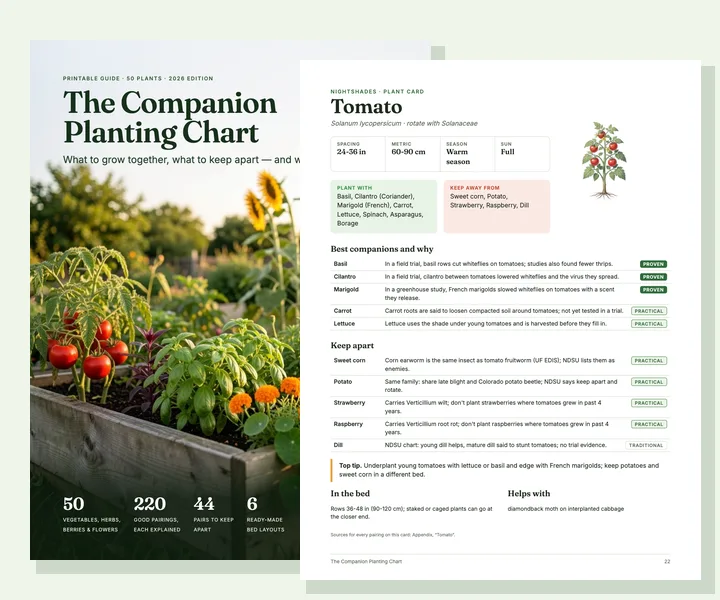
Free printable PDF
Get the complete companion planting chart
Print the three berry cards with the rotation gap for each, so you can check a spot's soil history before you buy plants.
- 1-page fridge chart + full 50 × 50 matrix
- 50 plant cards with spacing and reasons
- 6 bed plans drawn to scale
- US Letter and A4
Frequently asked questions
What is the best combination with strawberries?
Borage. In a UK garden trial, berry plants near borage cropped noticeably better, roughly a third more fruit, with more pollinators visiting. Equally important is what you avoid: skip any spot that grew nightshades recently, since they leave Verticillium wilt behind.
What should not be planted near blueberry bushes?
Anything that needs lime or near-neutral soil. Cabbage and its relatives need far less acidic soil than a blueberry's 4.5-5.5 and can overshadow new plants. Beans like pH close to 6.8. Most vegetables fall in that range, so grow blueberries in their own bed or in pots.
Can rhubarb be planted near raspberries?
None of our sources lists rhubarb and raspberry as foes or as friends, so there is no rule against it. Both are permanent plantings that like a bed edge. Give rhubarb about 36 inches (90 cm) and keep it clear of the raspberry rows so both stay easy to reach and harvest.
Should I plant two blueberry bushes together?
Yes, and preferably two or more varieties. Clemson notes that growing two or more varieties improves cross-pollination. For southern highbush, Clemson's spacing is 4-5 ft between bushes and 8-10 ft between rows, and keep them on acidic soil with pH 4.5-5.5.