Cabbage family
Broccoli Companion Plants: What to Grow With Broccoli
By the editorial team · Updated 2026-11-19 · Every pairing linked to its source
Quick answer. The best broccoli companion plants are thyme, onions and nasturtiums, which reduced cabbage looper and imported cabbageworm damage in an Iowa study, plus arugula sown a week or two early as a flea beetle trap crop. Beets fill the gaps between plants. Keep strawberries away; charts list them as incompatible with the cabbage family.
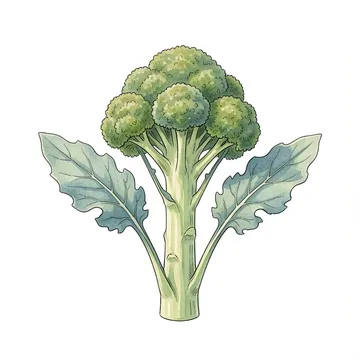
- Spacing
- 18-24 in · 45-60 cm
- Season
- Cool season
- Sun
- Full
- Rotate with
- Brassicaceae
Broccoli is a cool-season brassica for full sun, planted 18–24 in (45–60 cm) apart in rows about 36 in (90 cm) wide. Young transplants leave wide gaps, and it takes weeks for the leaves to close over the soil.
The pests that companion research targets on broccoli are caterpillars—cabbage looper and imported cabbageworm—plus flea beetles, which riddle young leaves with holes. Broccoli is one of the few crops where companion plants were measured against these pests in a field study, so the list below is more grounded than most.
Broccoli companion chart
Good companions
| Plant | Why | Evidence | |
|---|---|---|---|
| Arugula (rocket) | Sow arugula one to two weeks early as a trap crop that draws flea beetles off broccoli. | Proven | source |
| Nasturtium | In a field study, nasturtium cut cabbage looper and cabbageworm damage on broccoli. | Proven | source |
| Onion | In a field study, onions planted among broccoli cut cabbage looper and cabbageworm damage. | Proven | source |
| Thyme | In a field study, thyme reduced cabbage looper and cabbageworm damage on broccoli. | Proven | source |
| Beet | Beets fill the gaps between widely spaced broccoli plants. | Practical | source |
| Radish | Radish is used as a trap crop to draw flea beetles and root maggots off broccoli. | Practical | source |
| Celery | Celery is a traditional cabbage-family companion; no trial yet. | Traditional | source |
| Dill | A traditional broccoli partner; in one trial dill reduced aphids on cabbage. | Traditional | source |
| Sage | A traditional pairing; in a greenhouse, sage cut moth egg-laying on Brussels sprouts. | Traditional | source |
| Rosemary | Rosemary is traditionally said to help broccoli; no trial yet. | Traditional | source |
| Mint | Said to help broccoli in tradition; mint is very aggressive, so keep it in a pot. | Traditional | source |
Keep apart
| Plant | Why | Evidence | |
|---|---|---|---|
| Strawberry | Tradition keeps strawberries away from the cabbage family; no trial behind it. | Traditional | source |
Proven Backed by a field trial or published study. Practical Recommended by a university extension or the RHS, with a clear reason. Traditional Gardener lore; no trial found yet.
What to Plant With Broccoli
Against caterpillars
- Thyme — Proven. An Iowa study found thyme interplanted with broccoli reduced cabbage looper and imported cabbageworm damage.
- Onion — Proven. Onion interplanting reduced the same caterpillar damage in the Iowa study.
- Nasturtium — Proven. Nasturtium also cut looper and cabbageworm damage on broccoli in that study.
Against flea beetles
- Arugula — Proven. Sow it one to two weeks before the broccoli goes in, as a sacrificial trap crop that flea beetles find first.
- Radish — Practical. Utah State describes radish as a trap crop for flea beetles and root maggots, though no trial is cited.
Using the gaps
- Beet — Practical. UMass gives beets between broccoli plants as an interplanting example; they use the space before the broccoli spreads.
Traditional pairings
- Dill — the Almanac lists it for broccoli. Dill reduced cabbage aphids on cabbage in one trial, not on broccoli.
- Sage — listed by the Almanac; sage cut diamondback moth eggs on Brussels sprouts in a greenhouse.
- Celery — on the UC Davis and UF cabbage-family lists.
- Rosemary and mint — on an Oregon State sheet for cole crops. Oregon State warns mint is very aggressive, so grow it in a pot.
What Not to Plant With Broccoli
- Strawberry — Traditional. UC Davis and UF charts list strawberry as incompatible with the cabbage family.
UC Davis and UF also list tomato and pole beans as bad for the cabbage family, but this is tradition, and it conflicts with field trials. Several studies found tomato intercrops reduced diamondback moth on cabbage-family crops, though the tomatoes also competed for space. So tomatoes near broccoli are not clearly a mistake; the main issue is that both want room and sun.
Remember that radish, arugula, kale, cabbage and cauliflower are all brassicas. They're good neighbors this season, but rotate the whole family together.
The Arugula Trap Row
Flea beetles hit young brassica transplants hardest. The trap-crop approach is simple: sow a strip of arugula one to two weeks before you plant broccoli. The beetles settle on the arugula first, which takes pressure off the young broccoli. Treat the arugula as a sacrifice and don't count on eating it.
Combine it with the Iowa trio inside the bed—thyme and onions between plants, nasturtiums along the edge—and you cover both the early flea beetle stage and the caterpillars that follow.
Mixing Broccoli Varieties
One more option comes from a UC experiment cited by UMass: growing a mix of broccoli varieties reduced aphids compared with a single variety. It's an easy change if you're buying seed anyway. Pick two or three varieties and alternate them down the row.
Free printable PDF
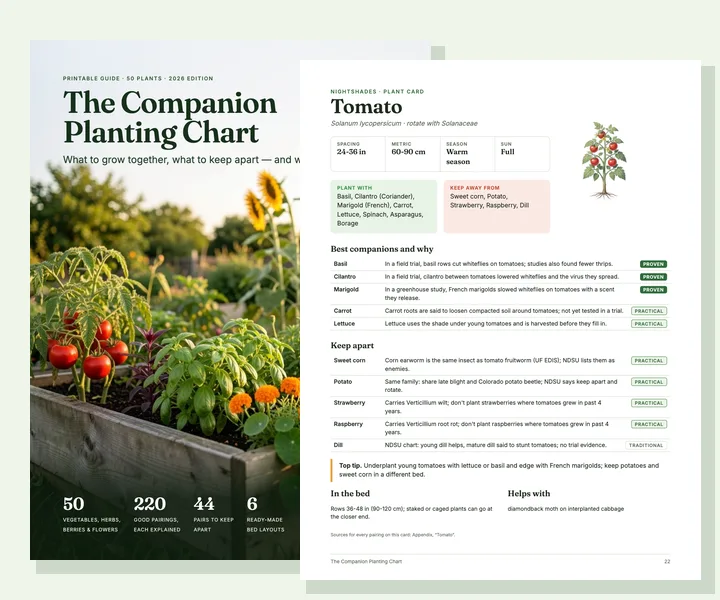
Get the complete companion planting chart
The pest-to-protector table in the PDF lines up flea beetles, loopers and cabbageworms with the companions that were actually tested against them.
- 1-page fridge chart + full 50 × 50 matrix
- 50 plant cards with spacing and reasons
- 6 bed plans drawn to scale
- US Letter and A4
Spacing Broccoli With Its Interplants
Broccoli at 18–24 in (45–60 cm) apart, in rows about 36 in (90 cm) wide, leaves room for three layers of companions:
- In the row: thyme or onions between plants, matching the Iowa interplanting.
- In the gaps: beets, harvested before the broccoli leaves meet.
- On the edges: nasturtiums and the arugula trap strip, kept slightly apart so flea beetles have somewhere to go that isn't the broccoli.
If you plant mint, keep it in a pot set into the bed rather than in the ground.
Does It Really Work?
Broccoli is one of the better-supported cases. Thyme, onion and nasturtium each reduced caterpillar damage in a field study, and arugula has research behind it as a flea beetle trap. The herb list beyond that is tradition, and the tomato warning on older charts conflicts with trial results.
Frequently asked questions
What can I not plant with broccoli?
Strawberries are the clearest foe: UC Davis and UF list them as incompatible with the cabbage family. Older charts also list tomatoes and pole beans as bad for broccoli, but field trials found tomato intercrops can reduce diamondback moth on brassicas, so that warning is weak. Rotate broccoli with other brassicas as one family.
What is the best companion plant for broccoli?
Thyme, onions and nasturtiums are the best-supported, since all three reduced cabbage looper and imported cabbageworm damage on broccoli in an Iowa study. Add an arugula strip sown one to two weeks early as a flea beetle trap crop. Beets fit well between broccoli plants to use the space.
What grows best beside broccoli?
Low crops that use the gaps while the broccoli is young: beets between plants, onions and thyme in the row, and nasturtiums along the edge. Radish and arugula can serve as flea beetle trap crops. Celery, dill and sage are traditional cabbage-family companions listed in university charts and the Almanac.
Can I plant broccoli and tomatoes together?
UC Davis and UF charts say no, but that is tradition. Several field trials found tomato intercrops reduced diamondback moth on cabbage-family crops, although the tomatoes competed with them. If you try it, give both crops their full spacing: broccoli 18–24 in (45–60 cm) and tomatoes 24–36 in (60–90 cm).