Guide
Does Companion Planting Work?
By the editorial team · Updated 2026-11-19 · Every pairing linked to its source
Quick answer. Some of it does. Trials support trap crops, flowers that feed pest predators and intercropping that gets more harvest from the same space. Many popular claims, such as marigolds repelling potato beetles or basil improving tomato flavor, failed when tested. The RHS view: benefits exist, but not for every crop every time.
Ask whether companion planting works and you'll get two confident answers: it's ancient wisdom, or it's folklore. The research supports neither extreme.
We traced every pairing in our 50-plant chart to its source. Of the 440 friendly pairings, 70 rest on a trial and 60 on an extension mechanism; the rest come from charts and tradition. Here is what that evidence actually says, and how to find out what works in your own beds.
What the trials support
The results that hold up fall into a few clear mechanisms:
Trap crops. Arugula sown ahead of brassicas draws flea beetles off them. Blue Hubbard squash traps cucumber beetles and squash bugs away from other cucurbits.
Habitat for predators. In New Jersey, eggplant edged with dill and coriander lost more potato beetle eggs to predators. Sunflower borders built up minute pirate bugs that suppressed thrips in Florida peppers. Borage near strawberries brought more pollinators and about 35% more fruit in one UK study.
Pest disruption by a neighbor. Coriander lowered whitefly and its virus on tomatoes in Brazil. Young onions cut carrot fly on carrots in the UK. An Iowa study recorded less caterpillar feeding on brassicas grown with onion, thyme, nasturtium or marigold. Dill reduced winged cabbage aphids in New Zealand.
Better use of space. A tomato-basil mix beat either crop alone on yield at West Virginia University, and the Three Sisters supplied more calories and protein per area in Cornell research.
What didn't hold up
- Flavor. Tasters in the West Virginia work, who didn't know which tomatoes were which, showed no steady preference for basil-grown fruit. Pests on tomato didn't respond to companions either; the gain was land use.
- Marigolds and potato beetle. Research such as Moreau's 2006 study saw no difference in beetle numbers.
- Marigolds between tomatoes for nematodes. UF/IFAS found interplanting doesn't appear effective. The effect comes from a dense block grown before the crop.
- More beneficials, fewer pests. An Oregon State SARE project saw more hoverfly eggs in broccoli next to insectary flowers, but no drop in cabbage aphids.
- Herbs as repellents. A Virginia study found certain herbs grown with collards actually increased cabbageworm egg-laying.
Even positive results come with fine print. Iowa State's trial on squash pests was small and its authors called the results indicative, not conclusive. The RHS points out that the marigold whitefly effect may partly come from plant diversity, since mixing tomatoes with other plants did something similar.
Intercropping: the science behind companion planting
Intercropping is the research term for growing two or more crops in the same space at the same time. The test is whether the mix produces more than the same land split into single-crop plots. In the examples behind our chart, the mixes that pass combine plants that differ in height, timing or root depth.
In a home garden that translates into a few patterns:
- Tall plus short: pole beans on corn; lettuce under tomatoes or in corn shade.
- Fast plus slow: the RHS describes lettuce and radish sown between slow crops like Brussels sprouts or sweet corn and harvested before they are shaded out.
- Early plus late: spinach sown early in a bed, with tomatoes or peppers transplanted in as it's harvested (University of Minnesota).
- Deep plus shallow: Oregon State notes that corn and bean roots feed at different depths.
Intercropping can backfire when one crop dominates. In Iowa State's Three Sisters trials, squash cut bean yields. Spacing is what keeps a mix productive.
Why charts and research disagree
Many companion charts copy each other, and a pair listed in three charts can still trace back to one untested claim. Sources also contradict each other. UF says sunflowers suit bush beans but not pole beans. A UC Davis chart rules out tomatoes near cabbage, while tropical studies show tomato rows can lower diamondback moth on that very crop. One chart lists basil as bad for beans; popular lore calls it a bean companion.
That's why our chart labels each pair Proven, Practical or Traditional and links the source. A Traditional pair isn't wrong. It just hasn't been tested.
How to test companion planting in your own garden
A simple side-by-side test tells you more than any chart:
- Pick one question. For example: does a dill strip reduce aphids on my cabbage?
- Make two matched plots. Same crop, same variety, same soil and sun. Add the companion to one plot only.
- Separate them. Put the plots far enough apart that insects can't move freely between them, or at least at opposite ends of the garden.
- Count on a schedule. Check the same number of plants every week and record pests or damage on each.
- Weigh the harvest from each plot.
- Repeat next season, swapping which plot gets the companion, since one year can mislead.
If the difference is small or flips between years, the companion probably isn't doing much in your conditions.
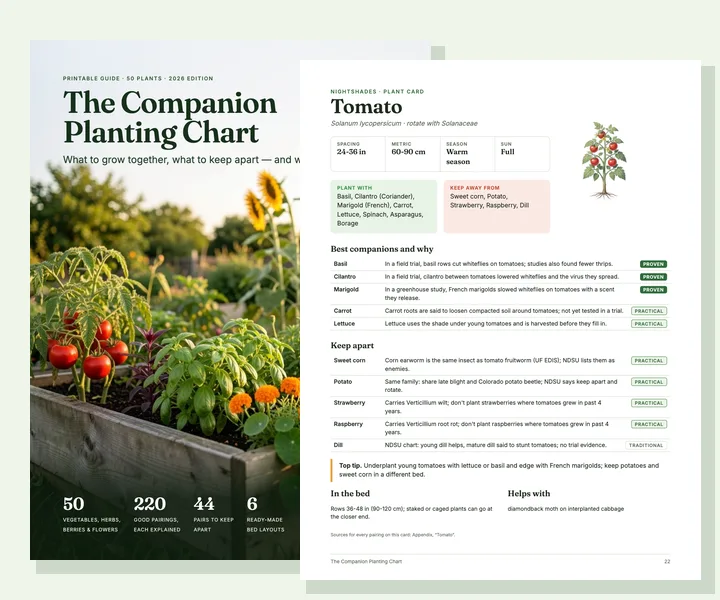
Free printable PDF
Get the complete companion planting chart
The kit's season planner and garden journal pages are laid out for exactly this kind of side-by-side test, with space for weekly pest counts and harvest weights.
- 1-page fridge chart + full 50 × 50 matrix
- 50 plant cards with spacing and reasons
- 6 bed plans drawn to scale
- US Letter and A4
Frequently asked questions
Is companion planting scientifically proven?
Parts of it are. Trials support trap crops, predator-feeding flowers and some intercrops, such as tomato with basil and the Three Sisters. Many chart pairings have never been tested, and some popular ones failed, including marigolds against Colorado potato beetle. Judge each pairing by its own evidence, not the practice as a whole.
What is intercropping in short?
Intercropping means growing two or more crops in the same space at the same time, so they share the plot rather than each getting their own. In home gardens it looks like pole beans on corn, lettuce under tomatoes or radishes between slow brassicas. It works best when the crops differ in height, timing or root depth.
What vegetables should not be planted beside each other?
The best-supported conflicts are tomatoes beside potatoes, which share late blight, and tomatoes beside sweet corn, which share the corn earworm. Nightshades also leave Verticillium wilt that harms later strawberries and raspberries. Many other foe pairs, such as onions beside beans, come from charts without trial evidence.
Does companion planting increase yield?
It can when the companion is also a crop. Mixed tomato and basil plots outproduced single crops at West Virginia University, and Cornell measured more food per area from the Three Sisters. Borage raised strawberry yields in one UK study. Crowding, though, can cut yields, as squash did to beans in Iowa State trials.
Sources
- rhs.org.uk — companion planting
- orgprints.org — 6614
- ojs.ethnobiology.org — 721
- extension.umn.edu — companion planting home gardens
- jstor.org — 42883179
- edis.ifas.ufl.edu — IN922
- doi.org — een.12880
- doi.org — jen.12558
- agris.fao.org — 65deb2ea0f3e94b9e5d08c14
- doi.org — 03015521.1988.10425616
- edis.ifas.ufl.edu — NG045
- doi.org — 0046 225X 29.5.1054
- extension.arizona.edu — CompanionPlantingApr2023
- extension.oregonstate.edu — companion planting
- mail.growables.org — CompanionGuideUF
- class.ucanr.edu — 301140