Guide
How to Grow a Salsa Garden
By the editorial team · Updated 2026-11-19 · Every pairing linked to its source
Quick answer. A salsa garden puts tomatoes, peppers, onions, garlic and cilantro in one bed. Cilantro is the key companion: organic tomatoes in Brazil had fewer whiteflies and less whitefly-spread virus when coriander grew between them. Because cilantro bolts in heat, sow it in several small batches and let some plants flower to feed hoverflies.
A salsa garden is a small kitchen bed built for one fresh recipe. The five ingredients cover two seasons, which is the only real puzzle: tomatoes and peppers want heat, while cilantro, onions and garlic prefer the cool end of the year.
Solve the timing and you get a bed that also works as a modest companion planting, with cilantro doing more for the tomatoes than most people expect.
The five salsa garden plants
- Tomato - the base of the salsa. Warm season, full sun.
- Pepper - mild or hot; our sources treat them as one crop. Warm season, full sun.
- Onion - cool season; sets go in 1.5-2 inches deep.
- Garlic - planted in fall and grown over winter.
- Cilantro - cool season, tolerates partial shade, bolts fast in hot weather.
Tomatoes and peppers are nightshades, onions and garlic are alliums, and cilantro belongs to the carrot family. Three families in one bed keeps rotation simple: next year, move the whole salsa bed and its nightshades come out of that soil.
Cilantro and tomatoes: the pair with evidence
Researchers in Brazil grew organic tomatoes with and without coriander (the name used for cilantro grown for seed) between the rows; the mixed plots had fewer whiteflies and less of the virus they carry. That makes cilantro one of only a few herbs with a measured effect on a tomato pest.
Its flowers help too. When Oregon State researchers compared early-season flowers, hoverflies, whose larvae eat aphids, chose coriander most often. So the plants you lose to bolting aren't wasted: leave a few to flower near the tomatoes.
One honest limit: a related Oregon State project found that more hoverflies didn't always mean fewer aphids on the crop. Treat the flowers as a helpful nudge, not a pest-control plan on their own.
Timing the salsa bed
Fall: plant garlic cloves 1 inch deep, 6 inches (15 cm) apart, along the south edge of the bed.
Early spring: set onion sets 3-4 inches (8-10 cm) apart next to the garlic. Make a first sowing of cilantro. Cilantro thinned to 10 inches (25 cm) grows full plants; sown thicker, about 5 cm apart, it gives leaves to cut young.
After frost: transplant tomatoes 24-36 inches (60-90 cm) apart along the north side and peppers 12-24 inches (30-60 cm) apart in front of them.
Through summer: sow a small batch of cilantro every few weeks in the light shade on the east side of the tomatoes. Let the oldest patch bolt and flower.
If you want cilantro and ripe tomatoes at the same moment, the succession sowing is what makes it possible. Because cilantro bolts quickly once the heat arrives, a single spring sowing may be finished before your first tomato colors.
Salsa garden layout for one raised bed
Think in three strips from north to south:
- North strip: tomatoes, staked or caged so they stay upright and can sit at the closer end of their spacing.
- Middle strip: peppers, with cilantro tucked in the gaps where it gets afternoon shade.
- South strip: onions and garlic, low enough that they don't shade anything.
The kit includes a salsa bed plan drawn to scale; for the general rules behind it, see the garden layouts guide.
What to keep out of the salsa garden
- Potatoes: they share late blight with tomatoes, and blight in one spreads to the other (NDSU).
- Sweet corn: corn earworm also attacks tomato fruit as tomato fruitworm.
- Beans and peas: charts from UC Davis and NDSU list the onion family as stunting legumes. It's a Traditional rating, but the salsa bed is full of alliums.
- Dill near mature tomatoes: NDSU says mature dill stunts tomatoes, while UF lists dill as a bad tomato companion outright. No trial supports either, but cilantro already fills the same role.
- Ground near a black walnut: juglone injures tomatoes and peppers.
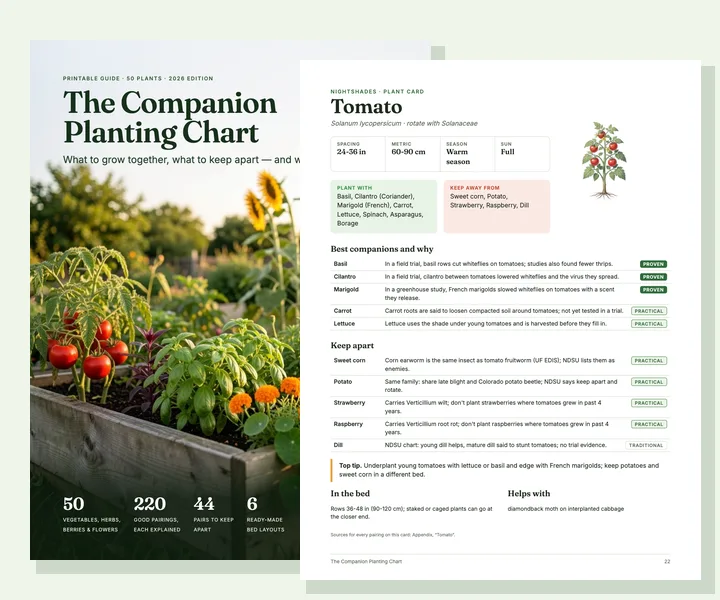
Free printable PDF
Get the complete companion planting chart
Print the salsa bed plan from the kit, with plant counts for each strip and a season planner that shows when to sow each batch of cilantro.
- 1-page fridge chart + full 50 × 50 matrix
- 50 plant cards with spacing and reasons
- 6 bed plans drawn to scale
- US Letter and A4
Frequently asked questions
Can tomatoes and cilantro grow side by side?
Yes. They are one of the better-supported pairs: in a Brazilian organic trial, a coriander intercrop reduced whitefly and whitefly-borne virus on tomatoes. Cilantro tolerates partial shade, so it can grow on the shady side of tomato plants, where it is easy to reach when you pick tomatoes for salsa.
What vegetables go in a salsa garden?
The standard salsa garden has tomatoes, peppers and onions, with garlic and cilantro for flavor. All five fit in one raised bed: tomatoes along the north side, peppers and cilantro in the middle, and onions and garlic along the south edge where they won't be shaded.
Why does my cilantro bolt before the tomatoes are ripe?
Cilantro is a cool-season herb and bolts fast in heat, while tomatoes ripen in the warmest weeks. Sow small batches every few weeks instead of all at once, and grow later sowings in partial shade. Let bolted plants flower; hoverflies feed on them.
Do jalapeños and tomatoes grow well together?
Yes. Our sources don't separate hot peppers from sweet ones, and none of our sources lists peppers and tomatoes as foes. Both are nightshades, so they share diseases and should move to a new bed together each year. Give peppers 12-24 inches (30-60 cm) so the tomatoes don't overshadow them.