Guide
Crop Rotation for the Home Vegetable Garden
By the editorial team · Updated 2026-11-19 · Every pairing linked to its source
Quick answer. Crop rotation in a home garden means grouping vegetables by plant family and moving each group to a different bed every year. Relatives share soil pests and diseases, so a gap lets those die down. A 4-bed, 4-year cycle keeps tomatoes and potatoes off the same soil for three years, as NDSU recommends.
Crop rotation sounds like a farm topic, but it matters just as much in four raised beds behind the house. The idea is simple: don't grow the same plant family in the same soil year after year.
This guide is for home vegetable gardens. It uses the families from our vegetable chart and turns them into a plan you can draw on the back of an envelope.
Why crop rotation works
Many garden problems live in the soil or overwinter near the plants they feed on. When their host returns to the same spot, they start the season with a head start.
The nightshades are the clearest example. Tomatoes, potatoes, peppers and eggplant share late blight and Colorado potato beetle, and they leave Verticillium wilt behind. NDSU advises three years out of the nightshade family after potatoes. The carrot family is another: carrots, celery, dill and parsley all share carrot fly.
Rotation won't cure an infection already in the soil. It lowers the odds of a buildup over several seasons, which is why it pays to start in year one.
Rotation groups by plant family
Botanical family decides the group, not how you eat the crop:
- Nightshades (Solanaceae): tomato, pepper, eggplant, potato.
- Cucurbits (Cucurbitaceae): cucumber, zucchini, winter squash, pumpkin, watermelon, cantaloupe.
- Legumes (Fabaceae): beans, peas.
- Brassicas (Brassicaceae): broccoli, cabbage, kale, cauliflower, Brussels sprouts, and also radish and arugula.
- Alliums (Amaryllidaceae): onion, garlic, chives.
- Carrot family (Apiaceae): carrot, celery, dill, cilantro, parsley.
- Beet family (Amaranthaceae): beet, spinach, Swiss chard.
- Small groups: lettuce (Asteraceae), sweet corn (Poaceae), okra (Malvaceae), sweet potato (Convolvulaceae).
Two surprises catch people. Radish is a brassica, so it follows cabbage-family rules. Sweet potato is not a nightshade, so it doesn't need to dodge tomato ground.
A 4-year crop rotation plan for four beds
Number your beds 1 to 4 and assign each group a starting bed. Every year, each group moves to the next number, and bed 4 goes back to bed 1.
| Year | Bed 1 | Bed 2 | Bed 3 | Bed 4 |
|---|---|---|---|---|
| 1 | Nightshades | Legumes + sweet corn | Brassicas | Cucurbits + roots |
| 2 | Cucurbits + roots | Nightshades | Legumes + sweet corn | Brassicas |
| 3 | Brassicas | Cucurbits + roots | Nightshades | Legumes + sweet corn |
| 4 | Legumes + sweet corn | Brassicas | Cucurbits + roots | Nightshades |
How the smaller groups fit:
- Alliums go with the brassicas. Onion interplanting reduced looper and cabbageworm damage on broccoli and cabbage in an Iowa trial, and it keeps onions out of the bean bed, which several charts advise.
- Carrot family and beet family share the cucurbit bed. Sow carrots and beets in spring, and let squash take over the space once they are pulled.
- Lettuce and spinach are flexible fillers. Sow them early in the nightshade bed; tomatoes and peppers can be transplanted in as you harvest.
- Sweet corn rides with the legumes, since pole beans climb it in the Three Sisters planting.
With this cycle, nightshades return to a bed only every fourth year, which meets the NDSU three-year gap.
Three beds or one small plot
With only three beds, merge the legume and brassica groups. Nightshades still come back only after two years away, which is shorter than NDSU's advice, so it helps to move potatoes to a separate spot or a large container.
In a single bed, rotate within it: split it into quarters and shift each family one quarter per year. Even a few feet of distance beats planting tomatoes in the identical spot every spring.
What stays out of the rotation
Perennials don't rotate. Asparagus and rhubarb need permanent beds, as do the woody herbs: rosemary, thyme, sage, oregano and lavender. Keep mint in a pot.
Berries need the most planning. Strawberries and raspberries should not go on ground that grew nightshades in the last 4-5 years, since the Verticillium they leave lingers (UNH, UMaine, Illinois). Choose their site with the full history of your beds in mind; see the berry companion planting page for details.
Rotation and nematodes
Root-knot nematodes feed on many crops, including okra, and they don't respect family lines. If you've seen knotted roots, the University of Florida describes one rotation step that does help: grow a dense block of French marigold for two months or more where next season's tomatoes or peppers will go, then dig it in. Scattered marigolds between crops don't give the same result.
Some garden writers add that squash and okra each feed the same nematodes, and suggest not putting one where the other just grew. That warning is Traditional, with no trial behind it.
Plant families at a glance
Rotate by family: crops in the same row below share pests and diseases, so move them together.
| Family | Plants in this chart |
|---|---|
| Brassicaceae | Broccoli, Cabbage, Kale, Cauliflower, Brussels sprouts, Radish, Arugula |
| Lamiaceae | Basil, Rosemary, Thyme, Oregano, Sage, Mint, Lavender |
| Cucurbitaceae | Cucumber, Zucchini, Winter squash, Pumpkin, Watermelon, Cantaloupe |
| Apiaceae | Carrot, Celery, Dill, Cilantro, Parsley |
| Solanaceae | Tomato, Pepper, Eggplant, Potato |
| Amaranthaceae (formerly Chenopodiaceae) | Beet, Spinach, Swiss chard |
| Asteraceae | Lettuce, Marigold, Sunflower |
| Fabaceae | Beans, Peas |
| Amaryllidaceae (onion family, formerly Alliaceae) | Onion, Garlic |
| Rosaceae | Strawberry, Raspberry |
| Convolvulaceae (not a nightshade) | Sweet potato |
| Asparagaceae | Asparagus |
| Polygonaceae | Rhubarb |
| Poaceae | Sweet corn |
| Malvaceae | Okra |
| Ericaceae | Blueberry |
| Amaryllidaceae (Allium) | Chives |
| Tropaeolaceae | Nasturtium |
| Boraginaceae | Borage |
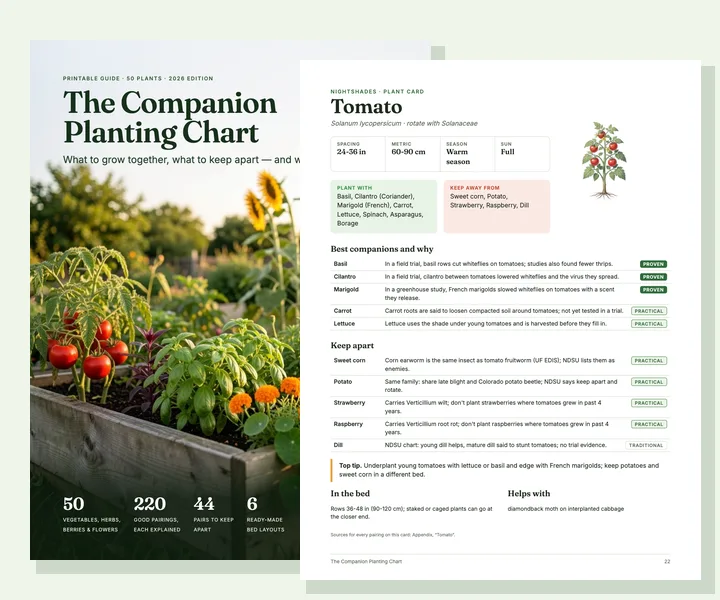
Free printable PDF
Get the complete companion planting chart
Print the rotation sheet from the kit, with all 50 plants already sorted into families and a four-year grid you can fill in with pencil.
- 1-page fridge chart + full 50 × 50 matrix
- 50 plant cards with spacing and reasons
- 6 bed plans drawn to scale
- US Letter and A4
Frequently asked questions
How does crop rotation work?
Pests and diseases that attack one plant family often survive in the soil or nearby. Moving that family to a new bed each year means they find no host when they emerge, so their numbers fall instead of building up. It works best when every member of a family moves together.
What vegetables do not need to be rotated?
Perennials stay in place: asparagus, rhubarb, strawberries, raspberries, blueberries and the woody herbs such as thyme, sage, rosemary and oregano. Quick fillers like lettuce can be tucked in almost anywhere, but if you sow them in the same spot every year, rotation is still good practice.
What is 4 crop rotation?
A four-group rotation divides the garden into four beds, usually nightshades, legumes, brassicas and a group of roots and cucurbits, and moves each group one bed per year. Each family returns to the same soil only every fourth year, which gives a three-year gap between plantings.
How many years should you wait before planting tomatoes in the same spot?
NDSU recommends keeping the nightshade family out of a bed for three years after potatoes, and the same logic applies to tomatoes, peppers and eggplant. A four-bed rotation achieves that. If late blight struck, move tomatoes and potatoes as far apart as you can, since blight passes between them.
Can I plant strawberries where tomatoes grew?
Not soon after. Tomatoes carry Verticillium wilt, and UNH Extension advises waiting 4 years before strawberries go there, while Georgia suggests 5. The same caution applies after potatoes, peppers and eggplant. Choose a strawberry site that has not grown nightshades for at least that long.
Sources
- ag.ndsu.edu — expect disease problems on potatoes and tomatoes
- extension.unh.edu — growing fruit strawberries fact sheet
- extension.umaine.edu — 2066e
- extension.illinois.edu — growing raspberries
- extension.umn.edu — companion planting home gardens
- edis.ifas.ufl.edu — NG045
- epicgardening.com — okra companion plants
- mail.growables.org — CompanionGuideUF