Flowers
Marigold Companion Planting
By the editorial team · Updated 2026-11-19 · Every pairing linked to its source
Quick answer. French marigold helps cabbage (fewer aphids and flea beetles in a Polish trial) and squash family crops (less squash bug and cucumber beetle damage in an Iowa trial). For root-knot nematodes it works only as a dense block grown 2+ months before tomatoes or peppers, not as scattered plants. No chart lists a foe.
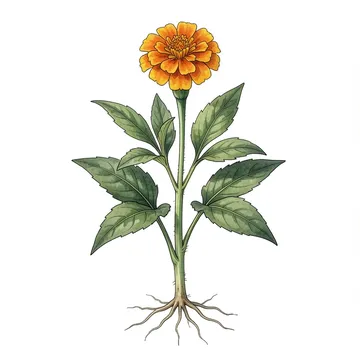
- Spacing
- 8-10 in · 20-25 cm
- Season
- Warm season
- Sun
- Full
- Rotate with
- Asteraceae
Marigold companion planting is one of the most repeated tips in gardening, and one of the most misunderstood. Many charts simply say marigolds deter nematodes next to tomatoes. The University of Florida's own review says something more specific: French marigold suppresses root-knot and lesion nematodes when grown as a dense cover crop for two months or more before the vegetable, and interplanting does not appear to be effective.
Marigolds do have real companion uses beside crops. A Polish field trial found fewer cabbage pests when French marigold was intercropped with cabbage, and an Iowa trial saw less squash bug and cucumber beetle damage around zucchini. This page sorts the proven uses from the overstated ones.
Marigold companion chart
Good companions
| Plant | Why | Evidence | |
|---|---|---|---|
| Cabbage | In a field trial, marigolds among cabbage meant fewer aphids, flea beetles and butterfly eggs. | Proven | source |
| Zucchini (summer squash) | In a farm trial, marigolds around zucchini cut squash bug and cucumber beetle damage. | Proven | source |
| Tomato | Marigold roots release a nematode-killing compound, but only as a dense crop before tomatoes. | Proven | source |
| Winter squash | In a farm study, marigolds helped cut squash bug and cucumber beetle damage on squash. | Proven | source |
| Pumpkin | In a farm study, marigolds helped cut squash bug and beetle damage on squash-family crops. | Proven | source |
| Pepper | Plant French marigold densely two months ahead of peppers to suppress root-knot nematodes. | Proven | source |
| Cucumber | In a farm study, cucumber-family crops ringed with marigolds suffered less squash bug and beetle damage. | Proven | source |
| Potato | Marigolds are often recommended with potatoes; no trial yet. | Traditional | source |
| Eggplant | Marigold is a traditional eggplant companion; untested — try it and see. | Traditional | source |
| Beans (bush & pole) | Beans are a traditional marigold partner; the bean beetle benefit is unverified. | Traditional | source |
| Sweet potato | Suggested for nematodes and beneficial insects; proven only when grown as a crop beforehand. | Traditional | source |
| Okra | Okra is a nematode host; grow marigold as a crop before okra, not alongside. | Traditional | source |
| Raspberry | Marigold edging is said to deter pests and draw pollinators; untested on raspberries. | Traditional | source |
| Basil | Basil is a traditional marigold companion; no trial yet. | Traditional | source |
Keep apart
No well-documented conflicts. See the notes below for general cautions.
Proven Backed by a field trial or published study. Practical Recommended by a university extension or the RHS, with a clear reason. Traditional Gardener lore; no trial found yet.
What to Plant With Marigolds
Proven companions
- Cabbage — Proven. In a Polish field trial, cabbage intercropped with French marigold had fewer cabbage aphids and flea beetles and less egg-laying by cabbage whites and cabbage moths. The same researchers found pot marigold (Calendula) even more effective.
- Zucchini and cucumber — Proven. An Iowa State farm trial found marigolds around zucchini reduced squash bug and striped cucumber beetle damage. The trial was small, and its authors called the results indicative, not conclusive.
- Winter squash and pumpkin — Proven by extension of the same cucurbit result; UC and NDSU also list marigold for them.
- Tomato — Proven, with a catch. A Newcastle study found French marigolds slowed glasshouse whitefly on tomato through airborne limonene. For nematodes, see the pre-crop method below.
- Pepper — Proven as a nematode pre-crop planted two months before.
Traditional listings: potato, eggplant, beans, sweet potato, okra, raspberry and basil appear in UF, UC, WVU and NDSU charts without trials.
What Not to Plant With Marigolds
No chart we used lists a vegetable that should not grow near marigolds. There are still three cautions from Clemson and the University of Florida:
- Virus host. Marigolds can carry tomato spotted wilt virus (Clemson). If that virus has been a problem, keep marigolds and tomatoes apart.
- The wrong marigold. Some cultivars, including 'Cracker Jack', an African type, host stubby-root and reniform nematodes. French types (Tagetes patula) work against the widest range.
- Height. African marigolds may need staking and can shade low crops; French marigolds stay compact.
Marigolds and Nematodes: The Pre-Crop Method
University of Florida guidance (Krueger and colleagues) found marigold suppresses 14 nematode genera, but only under the right conditions. In a field trial with cucurbits, interplanting showed no nematode effect; the positive result came only in pots. The method that works:
- Pick the bed where next season's tomatoes, peppers or okra will go.
- Sow French marigold densely, less than 7 in (18 cm) apart, as a solid block.
- Let it grow for at least two months.
- Dig it in, then plant the vegetable.
- Repeat each season before the crop; the effect does not carry over.
The roots release a nematicidal compound, alpha-terthienyl, which is why a dense stand matters. A handful of marigolds between tomato plants will not reach that density. The pest control companions guide shows how this fits with other methods.
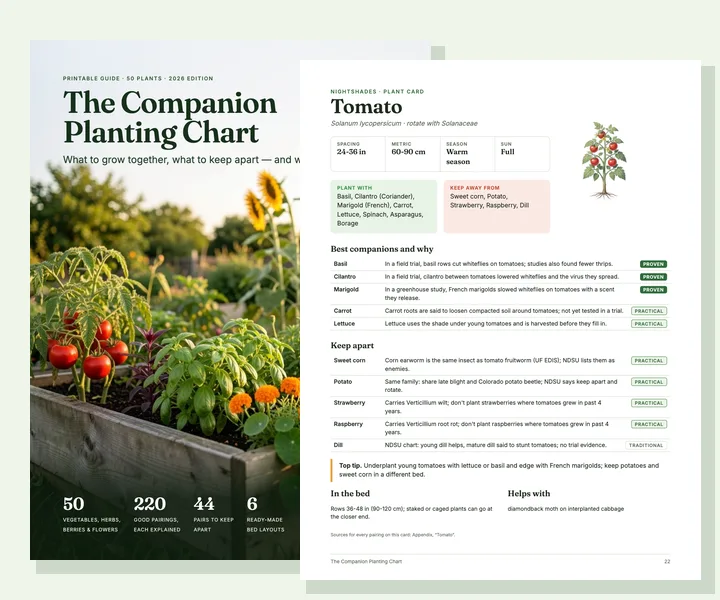
Free printable PDF
Get the complete companion planting chart
The PDF's pest-to-protector table and rotation sheet show where a marigold pre-crop goes a season ahead of your tomatoes, so the timing is on paper, not in your head.
- 1-page fridge chart + full 50 × 50 matrix
- 50 plant cards with spacing and reasons
- 6 bed plans drawn to scale
- US Letter and A4
Marigold Companion Plants by Spacing
| Use | Spacing | Source |
|---|---|---|
| French marigold, companion | 8–10 in (20–25 cm) | Clemson |
| African marigold | 12–16 in (30–40 cm) | Clemson |
| Nematode pre-crop | under 7 in (18 cm), solid block | UF/IFAS |
For cabbage and squash, plant French marigolds at normal spacing around or between the crop. For nematodes, switch to the dense pre-crop spacing in the bed you plan to use next.
Does It Really Work?
Yes, more than for most flowers, but not the way charts usually say. The cabbage and cucurbit trials support marigolds as true companions, and the whitefly result on tomatoes is encouraging. For nematodes, the evidence supports a dense pre-crop and does not support scattered interplanting. Many extension charts still overstate the interplant effect, and that is the misunderstanding to avoid.
Frequently asked questions
Is it good to plant marigolds in a vegetable garden?
Yes, with realistic expectations. French marigold intercropped with cabbage cut aphids, flea beetles and butterfly egg-laying in a Polish trial, and an Iowa trial saw less squash bug damage around zucchini. For nematodes, it works only as a dense block grown two months before the crop.
Do marigolds keep nematodes away from tomatoes?
Only if grown the right way. University of Florida guidance says French marigold suppresses root-knot nematodes as a dense cover crop grown 2+ months before tomatoes, then dug in. Interplanting a few marigolds among tomatoes does not appear to be effective.
What should not be planted near marigolds?
No chart we checked lists a vegetable that should not grow near marigolds. Cautions instead: marigolds can carry tomato spotted wilt virus, according to Clemson, and some African cultivars such as 'Cracker Jack' host stubby-root and reniform nematodes. Choose French types for nematode work.
Which marigold is best for companion planting?
French marigold (Tagetes patula) is the best-studied. UF guidance says French cultivars are effective against the widest range of nematodes, and the cabbage and squash trials used them. A Polish study found pot marigold (Calendula) even more effective on cabbage pests.
How far apart should marigolds be planted?
Clemson spaces French marigolds 8–10 in apart and African types 12–16 in. For nematode control, UF/IFAS advises planting French marigolds densely, under 7 in apart, as a solid block the season before the vegetable goes in, then digging the plants in.