Squash family
Cucumber Companion Plants: What to Plant With Cucumbers
By the editorial team · Updated 2026-11-19 · Every pairing linked to its source
Quick answer. The best cucumber companion plants are nasturtiums and marigolds, which reduced cucumber beetle and squash bug damage in an Iowa study. Beans add nitrogen, small vining cucumbers can climb sweet corn, and dill and borage bring beneficial insects and bees. Keep cucumbers away from potatoes and sage, both listed as incompatible.
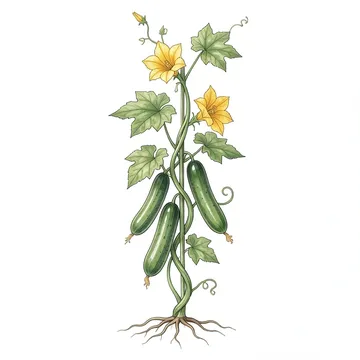
- Spacing
- 24 in · 60 cm
- Season
- Warm season
- Sun
- Full
- Rotate with
- Cucurbitaceae
Cucumbers are warm-season vines that need full sun and about 24 in (60 cm) per plant. Grown on the ground, rows run 48–72 in (120–180 cm) apart, which is a lot of bed for one crop. Trellised, they take a fraction of that and free the ground for low neighbors.
Two insects drive most cucumber companion choices: cucumber beetles, which chew plants and spread disease, and squash bugs. Cucumbers also depend on bees to set fruit, so flowers that keep pollinators around matter as much as any pest deterrent.
Cucumber companion chart
Good companions
| Plant | Why | Evidence | |
|---|---|---|---|
| Marigold (French) | In a farm study, marigolds helped cut squash bug and cucumber beetle damage on cucumbers. | Proven | source |
| Nasturtium | In research, nasturtium cut squash bugs and cucumber beetle damage on cucumber-family crops. | Proven | source |
| Beans (bush & pole) | Bean roots fix nitrogen; leave them in the soil to decay and feed cucumbers. | Practical | source |
| Sweet corn | Small vining cucumbers can climb corn stalks, giving them extra growing space. | Practical | source |
| Oregano | Oregano is said to deter pests in general near cucumbers; not trial-tested. | Traditional | source |
| Borage | A traditional cucumber partner; borage flowers draw bees to the bed. | Traditional | source |
| Dill | A traditional pairing; dill flowers draw hoverflies and wasps that hunt pests. | Traditional | source |
| Lettuce | A common pairing in gardening tradition; no trial yet — try it and see. | Traditional | source |
| Peas | Peas are a traditional cucumber partner; no trial evidence yet. | Traditional | source |
| Radish | Radish is said to lure cucumber beetles away; a traditional idea, unproven. | Traditional | source |
| Sunflower | A traditional pairing; sturdy sunflowers can support climbing cucumbers. | Traditional | source |
| Tomato | Grown side by side in many gardens; no trial yet, so judge by your results. | Traditional | source |
Keep apart
| Plant | Why | Evidence | |
|---|---|---|---|
| Potato | Traditionally kept away from potatoes; no reason documented, but easy to separate. | Traditional | source |
| Sage | Sage has long been called harmful to cucumbers; no trial yet, so play it safe. | Traditional | source |
Proven Backed by a field trial or published study. Practical Recommended by a university extension or the RHS, with a clear reason. Traditional Gardener lore; no trial found yet.
What to Plant With Cucumbers
Against cucumber beetles and squash bugs
- Nasturtium — Proven. Research cited by the University of Minnesota found nasturtium reduced squash bugs, and an Iowa study also recorded less cucumber beetle damage.
- Marigold — Proven. The same Iowa study found marigolds helped reduce squash bug and cucumber beetle damage on cucurbits.
Soil and structure
- Beans — Practical. Bean roots fix nitrogen. Leave the roots to decay in place after harvest and the nitrogen they release later benefits cucumbers.
- Corn — Practical. Small vining cucumbers, such as pickling types, can climb corn stalks, which adds growing space without a trellis.
- Oregano — Practical. NDSU lists oregano as a general pest deterrent near cucumbers. That's a claim from their list, not a trial.
Pollinators and predators
- Borage — Traditional. Oregon State's herb list singles out borage for cucumbers, and its flowers attract bees.
- Dill — Traditional. Listed in the UF chart. UMass notes dill flowers draw hoverflies and predatory wasps.
- Sunflower — Traditional. On the UC Davis chart, and Utah State notes sturdy sunflowers can support climbing cucumbers.
Also charted as compatible (Traditional): lettuce, peas, radish and tomato. The idea that radishes trap cucumber beetles is unproven.
What Not to Plant With Cucumbers
- Potato — Traditional. UC Davis and UF charts list potato as incompatible with cucumber. No mechanism is documented, but it's an easy rule to follow.
- Sage — Traditional. NDSU and UF charts say sage is injurious to cucumber. There is no trial evidence.
One honest complication: UC Davis lists "aromatic herbs" as incompatible with cucumbers, while Oregon State and UF recommend dill and borage. The charts simply disagree. Given that dill and borage both bring beneficial insects and bees, they are the herbs most worth trying.
Trellised Cucumbers and What to Grow Underneath
A trellis changes the whole bed. Once the vines climb, the soil at the base is free for short crops. Lettuce and radish both appear as cucumber companions in the charts, and both are quick enough to harvest before the vines get heavy. Put nasturtiums and marigolds along the outer edge where they won't climb into the trellis.
If you'd rather skip the trellis, a short row of sweet corn on the north side gives pickling cucumbers something to climb. Keep the corn far enough away that it doesn't shade the vines for most of the day.
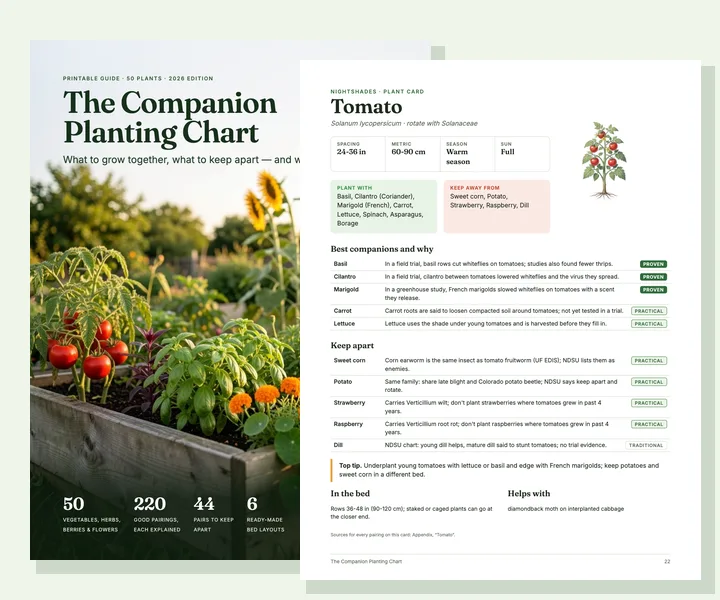
Free printable PDF
Get the complete companion planting chart
Print the cucumber card and the pest-to-protector table so the nasturtium and marigold border goes in on planting day, not after the beetles arrive.
- 1-page fridge chart + full 50 × 50 matrix
- 50 plant cards with spacing and reasons
- 6 bed plans drawn to scale
- US Letter and A4
Spacing Cucumbers and Their Neighbors
How much room the companions get depends on whether you trellis. On the ground, cucumbers need about 24 in (60 cm) per plant and rows 48–72 in (120–180 cm) apart, and the vines cover most of that by midsummer. On a trellis, the same plants take a narrow strip.
For a ground-grown bed:
- Put nasturtiums and marigolds at the ends and corners, where the vines are least likely to cover them.
- Grow beans in the bed the season before, or in the neighboring row, and leave the roots in the soil after harvest.
- Keep potatoes in a different part of the garden.
For a trellised bed, the base of the trellis becomes usable ground for lettuce or radish.
Does It Really Work?
For cucumbers, the nasturtium and marigold results are real: an Iowa study measured less beetle and squash bug damage. Beans and corn help in clear physical ways, through nitrogen and support. Most herb pairings are tradition, and the herb charts contradict each other. If you do only one thing, edge the cucumber bed with nasturtiums and marigolds.
Frequently asked questions
What is the best companion plant for cucumbers?
Nasturtium is the best-supported cucumber companion. Research cited by the University of Minnesota found it reduced squash bugs, and an Iowa study recorded less cucumber beetle damage. Marigolds showed a similar benefit in the same study. Plant both along the edges of the cucumber bed, and add borage or dill for bees and beneficial insects.
What should you not plant with cucumbers?
University charts list potatoes and sage as incompatible with cucumbers. UC Davis and UF give potato, and NDSU and UF say sage is injurious, though neither claim has a trial. UC Davis also warns against aromatic herbs in general, but other charts recommend dill and borage, so that advice is inconsistent.
Can you plant peppers and cucumbers together?
None of the extension charts we use list peppers as a cucumber friend or foe, so there's no known reason to keep them apart. Peppers are nightshades and cucumbers are cucurbits, so they don't share a rotation family. Give cucumbers their 24 in (60 cm) per plant, or trellis them so the vines don't shade the peppers.
Can cucumbers climb corn?
Small vining cucumbers can, and University extension sources list this as a practical way to add growing space. Choose compact pickling types rather than heavy slicers, and plant them once the corn is well established so the stalks can carry the vines. Sunflowers can serve the same purpose, according to Utah State.