Legumes
Peas Companion Planting: What to Grow With Peas (and What Not To)
By the editorial team · Updated 2026-11-19 · Every pairing linked to its source
Quick answer. Good pea companion plants are cool-season crops that fit around a trellis: lettuce and spinach at its foot, plus carrots, radishes, cucumbers and beans. All are traditional chart pairings. Keep peas away from onions, garlic and chives, which UC Davis, UF and NDSU say stunt them, and pair peas only with early potatoes.
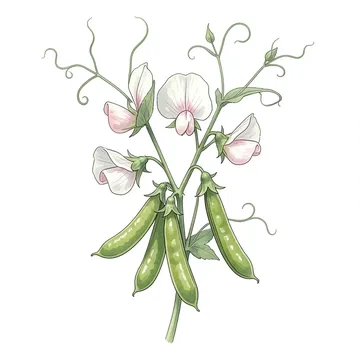
- Spacing
- 2-4 in · 5-10 cm
- Season
- Cool season
- Sun
- Full
- Rotate with
- Fabaceae
Peas are a cool-season legume for full sun, sown 2–4 in (5–10 cm) apart in rows 12–24 in (30–60 cm) wide. Most garden varieties climb, and a double row on either side of a trellis is a tidy way to grow them. That trellis leaves a narrow strip of shaded soil at its base, which is where the best pea companions go.
Peas are in the ground early and usually finish before summer heat. That timing shapes every companion choice: good partners are either fellow cool-season crops sown at the same time, or warm-season crops that take over the bed once the peas come out.
Peas companion chart
Good companions
| Plant | Why | Evidence | |
|---|---|---|---|
| Beans (bush & pole) | A traditional pairing; both are legumes, so rotate them together. | Traditional | source |
| Carrot | Carrots are a classic pea companion; no trial yet. | Traditional | source |
| Celery | Celery is a traditional pea partner; untested — try it and see. | Traditional | source |
| Sweet corn | Corn is an old pea companion in garden tradition; no trial evidence. | Traditional | source |
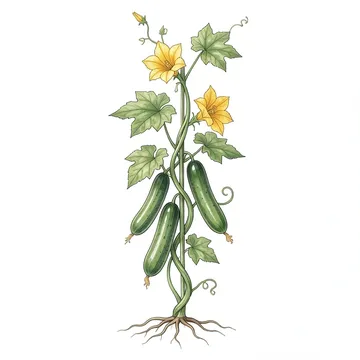
| Cucumber | Cucumbers are a traditional pea partner; no trial yet. | Traditional | source |
| Lettuce | Both like cool weather, and lettuce fits at the base of a pea trellis. | Traditional | source |
| Okra | Spring peas finish before warm-season okra fills the bed. | Traditional | source |
| Potato | Traditionally fine with early potatoes but not late ones; gardeners disagree here. | Traditional | source |
| Radish | Radish is a traditional pea companion; no trial evidence. | Traditional | source |
| Spinach | Both are cool-season crops, a traditional pairing for early spring. | Traditional | source |
| Sweet potato | Sweet potato is a traditional pea companion; no trial yet. | Traditional | source |
| Cilantro (Coriander) | Cilantro is traditionally said to help peas; untested. | Traditional | source |
| Rosemary | Rosemary is traditionally said to help peas; no trial yet. | Traditional | source |
| Sage | Sage is an old pea companion; worth a try, not yet tested. | Traditional | source |
Keep apart
| Plant | Why | Evidence | |
|---|---|---|---|
| Chives | Tradition keeps the whole onion family away from peas; no trial has shown harm. | Traditional | source |
| Garlic | Garlic is traditionally kept away from peas; the reason has never been tested. | Traditional | source |
| Onion | Gardeners have long warned against onions near peas; untested, but easy to avoid. | Traditional | source |
Proven Backed by a field trial or published study. Practical Recommended by a university extension or the RHS, with a clear reason. Traditional Gardener lore; no trial found yet.
What to Plant With Peas
None of the pea pairings in our sources has a trial behind it, so every one below is Traditional. They still differ in how much sense they make in a real bed.
At the foot of the trellis
- Lettuce — the Almanac lists it with peas. Both are cool-season, and lettuce fits the shaded strip at the base of a pea trellis.
- Spinach — on the UF chart and in the Almanac; another cool-season crop that finishes about when the peas do.
In neighboring rows
- Carrot and radish — listed by both UC Davis and UF.
- Celery — listed by UF.
- Cucumber and corn — listed by UC Davis and UF; in practice these follow the peas rather than growing with them.
- Beans — listed by UF. Both are legumes, so rotate them as one group.
Taking over after the peas
- Okra — spring peas finish before warm-season okra fills the bed (garden advice).
- Sweet potato — the UF/IFAS chart lists it with peas, though in most areas they grow in different seasons.
Herbs: an Oregon State sheet lists cilantro, rosemary and sage as enhancing peas.
What Not to Plant With Peas
- Onion — Traditional. UC Davis, UF and NDSU all list the onion family as incompatible with peas. There is no trial, but it is one of the most consistent warnings across charts.
- Garlic — Traditional. Same family, same warning from UC Davis and UF.
- Chives — Traditional. UC Davis lists the whole onion family, chives included.
Outside our 50, UC lists gladiolus as bad for peas (Traditional).
Potatoes are a split decision. UF says peas are good with early potatoes but bad with late ones, while UC Davis lists potato as incompatible with peas. If you want to try it, use an early variety and harvest both before midsummer.
What to Plant at the Base of a Pea Trellis
A pea trellis with a double row either side leaves a strip of cool, partly shaded soil along its length. Lettuce and spinach both suit it. Sow them in the same weeks as the peas, between the double rows or just outside them, and cut them as the peas begin to crop.
Keep the onion family out of this strip even though it looks like a good place for a row of green onions. Every major chart we checked advises against it.
How Close Can Peas Be Planted Together?
Peas tolerate close spacing: 2–4 in (5–10 cm) between seeds, in rows 12–24 in (30–60 cm) apart. On a trellis, the double-row layout puts two lines of peas a few inches either side of the support. Companions go beyond those rows, not between individual pea plants.
Free printable PDF
Get the complete companion planting chart
Use the season planner in the PDF to time peas, lettuce and the warm-season crop that follows, so the bed never sits empty.
- 1-page fridge chart + full 50 × 50 matrix
- 50 plant cards with spacing and reasons
- 6 bed plans drawn to scale
- US Letter and A4
What to Plant After Peas
Peas are usually done by early summer, which leaves the bed free. Garden advice suggests okra, which fills the space once the weather warms. Cucumbers and corn, both on the UC Davis and UF pea lists, are other warm-season crops for the same bed. Avoid following peas with beans, because both are legumes and rotate as one family.
Does It Really Work?
Pea companion planting is tradition from end to end in our sources. What it gives you is good use of a cool-season bed: lettuce and spinach under the trellis, a warm-season crop after. The onion-family warning has no trial, but every chart agrees on it, so there's little reason to test it in your own beds.
Frequently asked questions
What should you not plant next to peas?
Keep onions, garlic and chives away from peas. UC Davis, UF and NDSU charts list the onion family as incompatible, saying it stunts peas, though no trial has confirmed it. UC also lists gladiolus as bad. Potatoes are disputed: UF accepts early potatoes beside peas, while UC Davis lists potato as incompatible.
What plants go well with peas?
Lettuce and spinach are the most practical, because they are cool-season crops that fit at the base of a pea trellis. Carrots, radishes, celery, cucumbers, corn and beans are also listed as pea companions in UC Davis and UF charts. Cilantro, rosemary and sage appear on an Oregon State herb sheet.
How close can peas be planted together?
Sow peas 2–4 in (5–10 cm) apart in rows 12–24 in (30–60 cm) wide. A double row on either side of a trellis works well. Keep companion crops like lettuce or spinach outside the pea rows rather than between individual pea plants, so the peas aren't crowded at the base.
Can peas and beans be planted together?
Yes. The UF chart lists bush and pole beans as pea companions. Both are nitrogen-fixing legumes, so treat them as one family in your rotation and avoid following one with the other in the same bed. In practice, peas are usually finished before beans need the space.