Guide
Companion Planting for Pest Control
By the editorial team · Updated 2026-11-19 · Every pairing linked to its source
Quick answer. Companion planting for pest control works in three ways: trap crops that lure pests off the main crop, flowers that feed predators and parasitic wasps, and mixed plantings that make crops harder for pests to find. The best-supported examples are arugula for flea beetles, cilantro and basil against tomato whitefly, and onions against carrot fly.
Most lists of pest-repelling plants promise more than the research delivers. A plant that smells strong to you doesn't necessarily confuse an insect, and several famous claims have been tested and failed.
This guide goes pest by pest. For each one we name the protector plant, how it works and an evidence label: Proven for a trial result, Practical where an extension service or the RHS explains the mechanism, and Traditional where it is chart lore with no test.
Pest to protector table
| Pest | Crop | Protector | How | Evidence |
|---|---|---|---|---|
| Whitefly | Tomato | Basil, cilantro, French marigold | Intercrop; marigold releases limonene | Proven (Kenya, Brazil, Newcastle glasshouse) |
| Thrips | Pepper | Sunflower border | Builds minute pirate bugs that eat thrips | Proven (Florida) |
| Colorado potato beetle eggs | Eggplant | Dill and cilantro strips | Feeds ladybirds and lacewings | Proven (New Jersey) |
| Flea beetles | Broccoli, cabbage, kale | Arugula sown 1-2 weeks early | Sacrificial trap crop | Proven |
| Cabbage looper, imported cabbageworm | Broccoli, cabbage | Onion, thyme, nasturtium, marigold | Interplant | Proven (Iowa) |
| Diamondback moth | Brussels sprouts | Sage, thyme | Fewer eggs laid | Proven (greenhouse) |
| Cabbage aphid | Cabbage | Dill, French marigold | Intercrop | Proven (New Zealand, Poland) |
| Carrot fly | Carrot | Young onions | Interplant; fades once onions bulb | Proven (UK) |
| Squash bug, cucumber beetle | Zucchini, cucumber, squash | Marigold, nasturtium | Border planting | Proven, small trial (Iowa) |
| Root-knot nematodes | Tomato, pepper | French marigold | Dense pre-crop for 2+ months, dug in | Proven (UF/IFAS) |
| Cabbage root fly | Cabbage, cauliflower | Clover or trefoil underplanting | Hides the crop from the fly | Practical (RHS) |
| Aphids | Lettuce | Sweet alyssum | Feeds aphid predators | Practical (RHS) |
| Tomato hornworm | Tomato | Borage | Said to deter | Traditional |
The kit prints this table on one page, with every source listed.
Trap crops: luring pests away
A trap crop is a plant pests prefer, placed so they gather on it instead of your main crop. You sacrifice the trap plant.
- Arugula for flea beetles. Arugula is itself a brassica and a flea beetle magnet. Sow it 1-2 weeks before your broccoli, cabbage, kale or cauliflower. Minnesota Extension notes that a blend of at least three trap plants outperforms any one on its own.
- Nasturtium for blackfly and cabbage whites. Blackfly colonize it and cabbage whites choose it for their eggs. The RHS calls the evidence limited, and a Canadian study found some black bean aphid populations live on nasturtium while others don't. Check it often and pull heavily infested plants.
- Blue Hubbard squash traps cucumber beetles, squash bugs and squash vine borer away from other cucurbits.
- Collards on the garden perimeter lure diamondback moth away from cabbage, according to a UW-Extension column.
- Sunflower with sorghum draws stink bugs, including brown marmorated stink bug. One pepper trial found the reduction real but too small to be economic for a farm.
Beneficial insects: feeding the pest-eaters
Many companions work by feeding predators and parasitic wasps rather than by repelling anything:
- Hoverflies, whose larvae eat aphids, fed most on coriander among early-season flowers in Oregon State trials.
- Ladybirds and lacewings visit dill umbels; in the New Jersey eggplant trial they raised predation of potato beetle eggs.
- Minute pirate bugs build up on sunflowers and move into peppers.
- Parasitic wasps such as Aphidius colemani are attracted to aphid-infested borage, which greenhouse strawberry growers use as a banker plant.
- Corn earworm predators increased when buckwheat, cowpea or sunn hemp flowered beside sweet corn (University of Minnesota).
The catch: in an Oregon State SARE project, broccoli beside insectary flowers got more hoverfly eggs but no fewer cabbage aphids. Beneficials need time and numbers, and they won't rescue a crop already overrun.
Claims that didn't hold up
- Marigolds against Colorado potato beetle: tested and found wanting (Moreau et al., 2006, among others).
- Eggplant as a trap crop for potato beetle: the University of Minnesota's own trial showed no effect.
- Marigolds dotted among tomatoes for nematodes: UF/IFAS found intercropping doesn't appear to work; the effect needs a dense block grown ahead of the crop.
- Herbs around brassicas: a Virginia study found some companion herbs increased imported cabbageworm egg-laying on collards.
- Basil repelling tomato hornworm and whitefly: Arizona Extension slides repeat it citing a blog, while West Virginia University trials found pests on tomato didn't respond to companions.
- Repellent herbs in general: claims for rosemary, mint, chives, oregano and sage come from extension charts, not trials.
The RHS also notes that part of the marigold whitefly effect may come from plant diversity in general, since mixing tomatoes with other plants had a similar result.
Putting it together in one bed
Pick the pest you actually have, choose one protector from the Proven rows, and place it where it works: trap crops at the bed end, predator flowers at the edges, interplants between rows. Record pest counts for a few weeks so you know whether it helped.
For how these protectors fit into a full plan, see the garden layouts guide. For the bigger question of how much of companion planting is real, read does companion planting work?
Pest-helper plants at a glance
| Plant | What it does |
|---|---|
| Tomato | diamondback moth on interplanted cabbage (tropical field trials; tomato also competes with cabbage) |
| Winter squash | Blue Hubbard varieties trap cucumber beetles, squash bugs and squash vine borer away from other cucurbits |
| Onion | carrot fly on interplanted carrots (only while onions are young and leafy) |
| Onion | onion thrips reduced when mixed with carrots |
| Radish | flea beetles and root maggots (trap-crop claim, no trial cited) |
| Arugula | flea beetles (as a sacrificial trap crop for other brassicas) |
| Sweet corn | visual deterrent to squash vine borer in a Three Sisters planting (UMN claim) |
| Basil | thrips and asparagus beetle (extension list claim, not trial-tested) |
| Cilantro | aphids, spider mites, whitefly (extension claim, not trial-tested) |
| Rosemary | cabbage moth, bean beetles, carrot fly (extension chart claims, not trial-tested) |
| Thyme | whitefly, cabbage worm (extension chart claims, not trial-tested) |
| Oregano | aphids (distracts - extension claim, not trial-tested) |
| Sage | cabbage moth, carrot fly, flea beetle (extension chart claims, not trial-tested) |
| Chives | cabbage looper, cabbage maggot, carrot rust fly (distracts - extension claim, not trial-tested) |
| Mint | cabbage moth/looper, cabbage maggot, ants (extension chart claims, not trial-tested) |
| Lavender | moths (UF herb chart claim) |
| Marigold | root-knot (Meloidogyne) and lesion nematodes - suppressed when grown as a dense cover crop 2+ months before the vegetable |
| Marigold | cabbage aphid, flea beetles, cabbage white and cabbage moth egg-laying reduced in a cabbage intercrop trial |
| Marigold | squash bug and striped cucumber beetle damage reduced around zucchini (small Iowa trial) |
| Nasturtium | trap plant for black bean aphid (blackfly) and cabbage white caterpillars - hosts them; check and remove infested plants |
| Nasturtium | squash bugs (reduced around zucchini in a small Iowa trial) |
| Nasturtium | flea beetles (trap crop - Arizona Extension) |
| Sunflower | trap crop for stink bugs (incl. brown marmorated stink bug, with sorghum) |
| Sunflower | aphids and ants gather on it (trap/distraction) |
| Borage | tomato hornworm (UF herb chart claim, not trial-tested) |
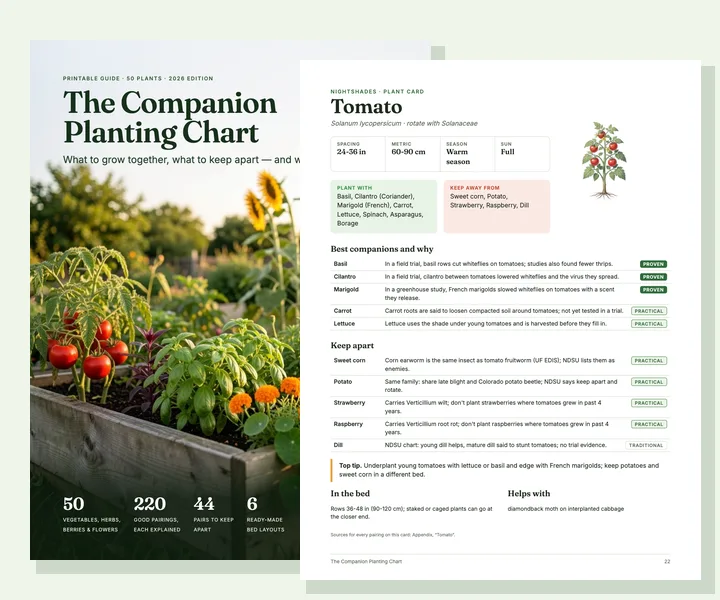
Free printable PDF
Get the complete companion planting chart
Print the pest-to-protector table from the kit and keep it in the shed, so the right trap crop or flower goes in before the pest arrives.
- 1-page fridge chart + full 50 × 50 matrix
- 50 plant cards with spacing and reasons
- 6 bed plans drawn to scale
- US Letter and A4
Frequently asked questions
What plants deter pests?
Fewer than charts suggest. The plants with trial support mostly lure or feed rather than repel: arugula as a flea beetle trap, sunflowers that host thrips-eating pirate bugs, dill and cilantro that feed ladybirds and hoverflies. In Iowa, caterpillars did less harm to cabbage-family crops grown among onions, thyme, nasturtiums or marigolds.
What plants should I avoid planting next to each other?
Pairs that share a pest or disease: tomatoes and potatoes (late blight, Colorado potato beetle) and tomatoes and sweet corn (corn earworm, also called tomato fruitworm). Carrots and celery share carrot fly. Our guide to plants not to grow together lists every documented conflict with its evidence label.
What is the Three Sisters planting method?
It is an Indigenous North American intercrop of corn, pole beans and squash. It is mainly a productivity system rather than pest control, though the University of Minnesota mentions a possible visual deterrent effect on squash vine borer. Its main benefit in Cornell research was more calories and protein from the same ground.
Do marigolds really keep bugs away?
Sometimes. French marigolds cut aphids, flea beetles and butterfly egg-laying on cabbage in Polish trials and slowed whitefly on tomato in a glasshouse study. Potato beetles ignored them in studies, and for nematodes you need a thick stand planted at least two months ahead.
Sources
- doi.org — agronomy6030042
- doi.org — jen.12558
- doi.org — journal.pone.0213071
- edis.ifas.ufl.edu — IN922
- jstor.org — 42883179
- extension.umn.edu — companion planting home gardens
- doi.org — j.1570 7458.1986.tb01029.x
- doi.org — 03015521.1988.10425616
- doi.org — fhort 2013 0129
- agris.fao.org — 65deb2ea0f3e94b9e5d08c14
- extension.arizona.edu — CompanionPlantingApr2023
- edis.ifas.ufl.edu — NG045
- rhs.org.uk — companion planting
- doi.org — s10340 017 0838 z
- doi.org — 0046 225X 29.5.1054
- jstage.jst.go.jp — article
- orgprints.org — 6614
- mail.growables.org — CompanionGuideUF