Leafy greens & perennials
Celery Companion Plants
By the editorial team · Updated 2026-11-19 · Every pairing linked to its source
Quick answer. Celery companion plants include onions, bush beans, tomatoes, peas, spinach and cabbage-family crops such as broccoli and cauliflower. Keep carrots and parsley away: they belong to celery's own family and share its pests. A University of Florida chart even calls celery compatible with almost everything.
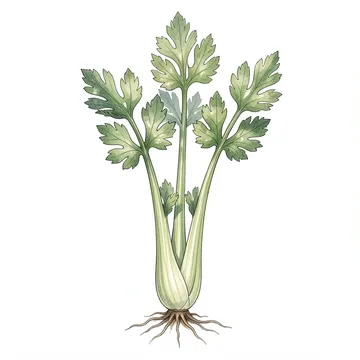
- Spacing
- 12 in · 30 cm
- Season
- Cool season
- Sun
- Full
- Rotate with
- Apiaceae
Celery companion plants are easy to choose because celery gets along with most of the vegetable garden. One University of Florida chart describes it as compatible with almost everything, and UC Davis lists a long run of partners from onions to tomatoes.
The exceptions are celery's relatives. Carrot, parsley and celery all sit in the Apiaceae family, and charts warn against grouping them. Everything on this page is a chart listing rather than a trial, so we label it Traditional and explain the practical logic where there is one.
Celery companion chart
Good companions
| Plant | Why | Evidence | |
|---|---|---|---|
| Beans (bush & pole) | Bush beans are a traditional celery companion; no trial yet. | Traditional | source |
| Broccoli | Broccoli is an old celery partner; untested — try it and see. | Traditional | source |
| Cabbage | Cabbage is a traditional celery companion; no trial evidence. | Traditional | source |
| Cauliflower | Cauliflower is a traditional celery partner; no trial yet. | Traditional | source |
| Nasturtium | Nasturtium is an old celery companion; no trial evidence. | Traditional | source |
| Onion | Onions are a classic celery companion; no trial yet. | Traditional | source |
| Peas | Peas are a traditional celery partner; untested. | Traditional | source |
| Spinach | Spinach is a traditional celery companion; no trial yet. | Traditional | source |
| Tomato | Tomatoes are an old celery companion; no trial yet — worth a try. | Traditional | source |
Keep apart
| Plant | Why | Evidence | |
|---|---|---|---|
| Carrot | Carrots are in the same family as celery and share its pests. | Traditional | source |
| Parsley | Parsley is in the same family as celery and shares its pests. | Traditional | source |
Proven Backed by a field trial or published study. Practical Recommended by a university extension or the RHS, with a clear reason. Traditional Gardener lore; no trial found yet.
What to Plant With Celery
Upright alliums
- Onion — Traditional. Both UC Davis and University of Florida list onions with celery. Two narrow, upright crops fit closely in a row.
Legumes
- Beans — Traditional. UC Davis names bush beans specifically; they stay low and leave celery its light.
- Peas — Traditional. Listed by the UF chart; peas finish early in the season.
The cabbage family
- Cabbage, Broccoli and Cauliflower — Traditional. UC Davis lists the whole group with celery.
Summer and leafy partners
- Tomato — Traditional. A UC Davis listing, with no mechanism given.
- Spinach — Traditional. Listed by UF; a quick cool-season crop for the gaps.
- Nasturtium — Traditional. UC Davis lists it with celery.
What Not to Plant With Celery
- Carrot — Traditional. The UF chart lists carrot as a bad companion. Carrot and celery are in the same family and share carrot fly and related diseases, so a mixed block gives those pests more to feed on.
- Parsley — Traditional. Also flagged by UF for the same family reason.
- Parsnip — not one of the 50 plants on this site, but UF lists it as bad for celery too.
The simplest fix is to treat carrot, parsley, dill, cilantro and celery as one rotation group and grow them apart from each other in the same season. The plants not to grow together guide lists the other family clashes.
Spacing Celery in a Mixed Bed
Utah State gives celery about 12 in (30 cm) between plants and rows about 24 in (60 cm) apart. Celery wants full sun and cool-season conditions, so place it where taller summer crops will not shade it.
A practical pattern: alternate celery and onions in one row, with bush beans or a brassica in the next row. The onions take little space, the beans stay low, and celery keeps its sun.
If your bed is small, skip the long companion list and pick two: onions for the row itself and one brassica or bean for the next row. Celery is a long-season crop, so fewer, well-chosen neighbors are easier to manage than a crowded mix that competes for water.
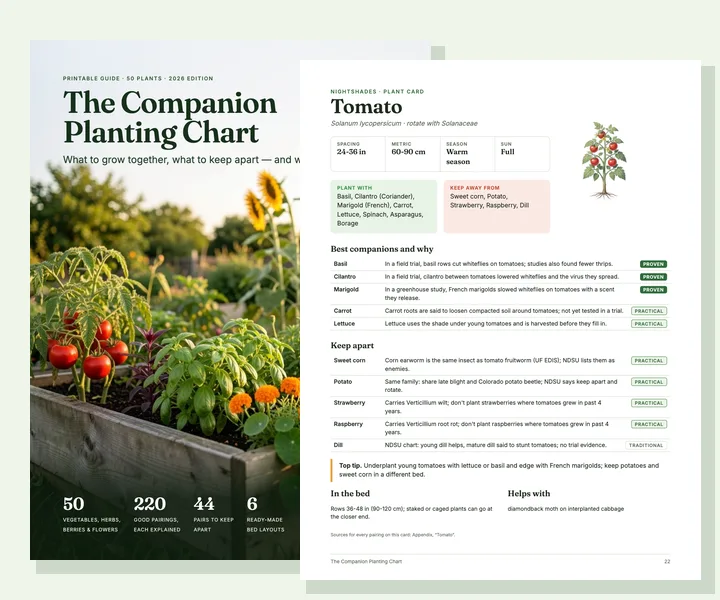
Free printable PDF
Get the complete companion planting chart
The PDF groups celery, carrot, parsley, dill and cilantro on one rotation sheet, so you can print it and keep the whole family in the right beds each year.
- 1-page fridge chart + full 50 × 50 matrix
- 50 plant cards with spacing and reasons
- 6 bed plans drawn to scale
- US Letter and A4
Celery Companion Planting Chart
| Plant | Next to celery? | Why | Evidence |
|---|---|---|---|
| Onion | Yes | Upright, narrow, listed by UC Davis and UF | Traditional |
| Bush beans | Yes | Low growth leaves celery its sun | Traditional |
| Peas | Yes | Early crop, listed by UF | Traditional |
| Tomato | Yes | Listed by UC Davis; plant on celery's shady side | Traditional |
| Spinach | Yes | Quick cool-season filler | Traditional |
| Cabbage family | Yes | Listed as a group by UC Davis | Traditional |
| Carrot | No | Same family, shares carrot fly | Traditional |
| Parsley | No | Same family, shares pests | Traditional |
The tomato row deserves a note. Tomatoes are spaced 24–36 in (60–90 cm) and grow tall, while celery needs full sun. Put celery on the south side of the tomato row in the Northern Hemisphere so it is not left in shadow by midsummer.
Celery is a cool-season crop that sits in the bed a long time, so quick partners such as spinach and peas can be sown and finished around it while the celery stalks fill out.
Does It Really Work?
No one has run a trial on celery companions. The friendly list reflects celery's easygoing nature in charts, and the warning about carrots and parsley rests on a sound idea: related plants share pests. That family logic is the part worth acting on. For what the research does show elsewhere, see does companion planting work.
Frequently asked questions
What vegetables can I plant with celery?
Onions, bush beans, peas, tomatoes, spinach and cabbage-family crops such as cabbage, broccoli and cauliflower are listed as celery companions in UC Davis and University of Florida charts. These are traditional pairings without trial data. Celery needs full sun, so place taller crops where they will not shade it.
What should you not plant around celery?
Keep carrots and parsley away from celery. The University of Florida chart lists both as bad companions because they belong to the same plant family and share pests such as carrot fly. UF also lists parsnip as a poor partner for the same reason.
Can you plant celery next to tomatoes?
Yes. The UC Davis chart lists tomato as a celery companion, though no mechanism is documented. Give celery about 12 in (30 cm) of space and set it on the sunny side of the tomatoes, since celery needs full sun and tall tomato plants can shade it.
Can I plant garlic next to celery?
No chart we checked lists garlic and celery together or apart. Onions, garlic's close relative, are listed as celery companions by UC Davis and University of Florida. Neither source flags a problem, so garlic is a reasonable neighbor if you have the space.
How far apart should celery be planted?
Utah State recommends about 12 in (30 cm) between celery plants, with rows roughly 24 in (60 cm) apart. That spacing leaves room to run a row of onions or bush beans between celery rows in a mixed bed, and it lets you reach in to harvest outer stalks without stepping on neighbors.