Cabbage family
Cabbage Companion Plants: What to Grow With Cabbage to Keep Bugs Away
By the editorial team · Updated 2026-11-19 · Every pairing linked to its source
Quick answer. The best cabbage companion plants are onions, marigolds, nasturtiums and dill, which cut caterpillars, aphids or flea beetles in field trials, plus an arugula strip sown early as a flea beetle trap. Beets, celery and spinach are traditional partners. Keep strawberries and blueberries away, and avoid black walnut.
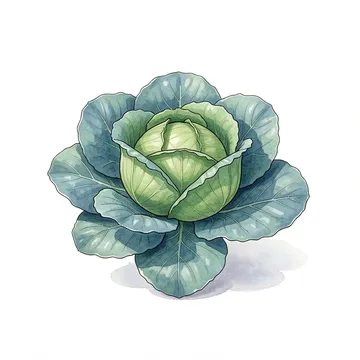
- Spacing
- 12-18 in · 30-45 cm
- Season
- Cool season
- Sun
- Full
- Rotate with
- Brassicaceae
Cabbage is a cool-season, full-sun brassica, spaced 12–18 in (30–45 cm) apart in rows about 36 in (90 cm) wide. It forms one tight head per plant, so the leaves are the crop, and every hole a caterpillar or flea beetle chews shows up at harvest.
That's why cabbage companion planting is mostly about pests: imported cabbageworm, cabbage looper, cabbage aphid, flea beetles, diamondback moth and cabbage root fly. Cabbage has more trial results behind its companions than almost any other vegetable, and also one study showing that the wrong herbs can backfire.
Cabbage companion chart
Good companions
| Plant | Why | Evidence | |
|---|---|---|---|
| Arugula (rocket) | Sow arugula one to two weeks early as a trap crop that draws flea beetles off cabbage. | Proven | source |
| Dill | In a field trial, cabbage grown with dill had fewer winged aphids. | Proven | source |
| Marigold (French) | In field trials, marigolds among cabbage cut aphids, flea beetles and butterfly egg-laying. | Proven | source |
| Nasturtium | In a field study, nasturtium cut cabbage looper and cabbageworm damage on cabbage. | Proven | source |
| Onion | In a field study, onions planted among cabbage reduced looper and cabbageworm damage. | Proven | source |
| Radish | Radish is used as a trap crop to draw flea beetles and root maggots off cabbage. | Practical | source |
| Sage | Sage is said to deter cabbage moths; that idea has not been tested. | Traditional | source |
| Lavender | Lavender flowers draw pollinators to the cabbage patch. | Practical | source |
| Beet | Beets are a traditional cabbage companion; no trial yet. | Traditional | source |
| Celery | Celery is a classic cabbage-family partner; untested — try it and see. | Traditional | source |
| Garlic | Garlic is said to improve cabbage growth; an old idea, unverified. | Traditional | source |
| Mint | Mint is said to deter cabbage moths; unverified, and keep mint in a pot. | Traditional | source |
| Potato | Potatoes are a traditional cabbage-family companion; no trial evidence. | Traditional | source |
| Rosemary | Rosemary is said to deter cabbage moths; no trial has confirmed it. | Traditional | source |
| Spinach | Spinach is a traditional cabbage companion; no trial yet. | Traditional | source |
| Swiss chard | Chard is an old cabbage-family partner; untested, so watch your own beds. | Traditional | source |
| Thyme | Thyme is said to deter cabbageworm; its trial results came from broccoli, not cabbage. | Traditional | source |
| Chives | Traditionally said to help cabbage; chives may distract cabbage maggots. | Traditional | source |
Keep apart
| Plant | Why | Evidence | |
|---|---|---|---|
| Strawberry | Strawberries are traditionally kept away from cabbage; no trial has tested this. | Traditional | source |
| Blueberry | Cabbage wants much higher soil pH than blueberries' 4.5–5.5 and can shade young bushes. | Traditional | source |
Proven Backed by a field trial or published study. Practical Recommended by a university extension or the RHS, with a clear reason. Traditional Gardener lore; no trial found yet.
What to Plant With Cabbage
Companions with trial results
- Onion — Proven. In an Iowa study, onion interplanting reduced cabbage looper and imported cabbageworm damage on cabbage.
- Marigold — Proven. Polish trials found marigold intercrops cut cabbage aphids, flea beetles and butterfly egg-laying. The Iowa study also recorded less caterpillar damage.
- Nasturtium — Proven. Reduced looper and cabbageworm damage on cabbage in the Iowa study.
- Dill — Proven. Cabbage intercropped with dill had fewer winged cabbage aphids in a New Zealand field trial.
- Arugula — Proven. Sown one to two weeks earlier as a sacrificial flea beetle trap crop.
Extension-backed
- Radish — Practical. Used as a trap crop for flea beetles and root maggots (Utah State; no trial cited).
- Sage — Practical. The UF herb chart and NDSU list it to deter cabbage moth, an untested claim.
- Lavender — Practical. Oregon State lists it for cole crops; its flowers draw pollinators.
Traditional pairings
Beet, celery, spinach, Swiss chard and potato appear on the UC Davis or UF cabbage-family lists. Garlic, chives, rosemary, thyme and mint are listed against cabbage moth or worms without trial support. If you plant mint, keep it in a pot.
What Not to Plant Beside Cabbage
- Strawberry — Traditional. UC Davis and UF list strawberry as incompatible with the cabbage family.
- Blueberry — Traditional. A soil conflict: brassicas want a much higher pH than the 4.5–5.5 blueberries need, and cabbage can shade young bushes.
Outside our 50, Purdue notes black walnut affects cabbage. Charts also list kohlrabi, tomato and pole beans as bad neighbors (Traditional). The tomato listing conflicts with field trials that found tomato intercrops reduced diamondback moth on cabbage, at the cost of some competition.
What to Plant With Cabbage to Keep Bugs Away
Match the companion to the pest:
- Caterpillars (loopers, cabbageworm): onions, marigolds and nasturtiums inside the bed.
- Cabbage aphid: dill or marigold intercrops.
- Flea beetles: an arugula or radish strip sown early, plus marigolds.
- Cabbage root fly: the RHS reports that underplanting with clover or trefoil reduces it.
- Diamondback moth: a UW-Extension column notes collards planted around the garden perimeter lure it away from cabbage.
No single companion covers everything, and none replaces checking under the leaves.
Why Some Herbs Can Backfire
Herbs are the usual cabbage advice, but the evidence is mixed. A Virginia study found some companion herbs grown with collards increased imported cabbageworm egg-laying. Most herb claims for cabbage—rosemary, mint, thyme, sage—come from charts, and the thyme result from Iowa was measured on broccoli, not cabbage. If you want reliable results, lean on onions, marigolds, nasturtiums and dill first.
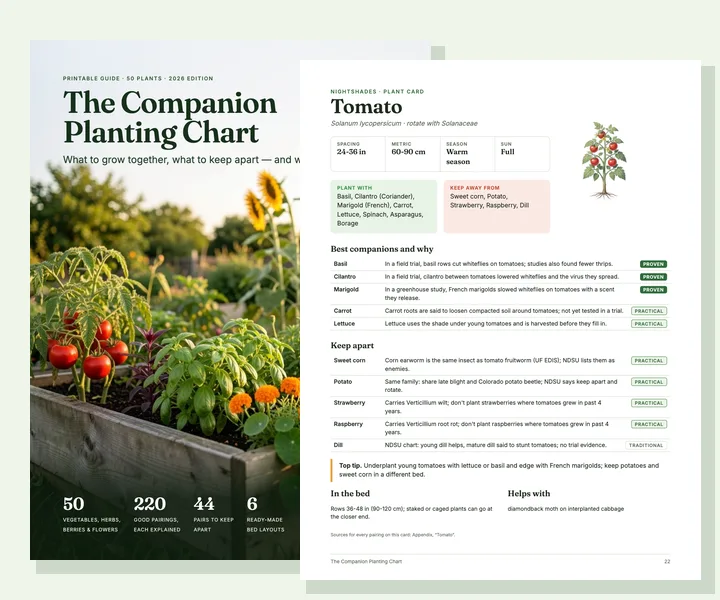
Free printable PDF
Get the complete companion planting chart
Print the cabbage card and the pest-to-protector table and you'll know which companion answers which pest before the first moth shows up.
- 1-page fridge chart + full 50 × 50 matrix
- 50 plant cards with spacing and reasons
- 6 bed plans drawn to scale
- US Letter and A4
Laying Out a Cabbage Bed With Companions
Cabbage goes 12–18 in (30–45 cm) apart, closer than broccoli, so companions need planning. One workable layout:
- Onions between cabbage plants in the row.
- A block of dill at one end, where it can flower without shading the heads.
- Marigolds and nasturtiums along the long edges.
- An arugula strip sown early outside the bed.
- Clover sown between rows if cabbage root fly has been a problem.
Keep strawberries and blueberries in their own part of the garden.
Does It Really Work?
For cabbage, more than for most crops. Onion, marigold, nasturtium and dill all have field results, and arugula works as a trap. But the herb claims are inconsistent, and one study shows a reverse effect. Read the full pest control guide for how trap crops and intercrops differ.
Frequently asked questions
What to plant with cabbage to keep bugs away?
Onions, marigolds and nasturtiums reduced cabbage looper and imported cabbageworm damage in an Iowa study. Dill cut cabbage aphids in a New Zealand trial, and marigolds also reduced aphids and flea beetles in Polish trials. Sow arugula one to two weeks early as a flea beetle trap, and underplant clover against cabbage root fly.
What not to plant beside cabbage?
UC Davis and UF list strawberries as incompatible with cabbage. Blueberries need far more acidic soil than brassicas and can be shaded by them. Black walnut affects cabbage, and charts also list kohlrabi, tomatoes and pole beans as poor neighbors, though trials suggest tomatoes can reduce diamondback moth.
Does mint keep cabbage moths away?
NDSU and UF charts say mint deters cabbage moth, but the claim hasn't been verified. A Virginia study even found some companion herbs increased cabbageworm egg-laying on collards. If you grow mint near cabbage, keep it in a pot, because it spreads aggressively into beds.
Can cabbage and tomatoes be planted together?
Charts from UC Davis say no, but field trials, including one in Puerto Rico, found tomato intercrops reduced diamondback moth on cabbage. The tomatoes also competed with the cabbage. If you try it, space generously: cabbage at 12–18 in (30–45 cm) and tomatoes at 24–36 in (60–90 cm).